<?xml version="1.0" encoding="utf-8"?><feed xmlns="http://www.w3.org/2005/Atom" ><generator uri="https://jekyllrb.com/" version="3.10.0">Jekyll</generator><link href="https://julsraemy.ch/feed.xml" rel="self" type="application/atom+xml" /><link href="https://julsraemy.ch/" rel="alternate" type="text/html" /><updated>2026-06-17T08:36:14+02:00</updated><id>https://julsraemy.ch/feed.xml</id><title type="html">Julien A. Raemy</title><subtitle>Thoughts and discombobulations of Julien A. Raemy, an Information Specialist and Digital Humanities Practitioner interested in information interoperability, knowledge representation, Linked Open Usable Data (LOUD), digital preservation, Science and Technology Studies (STS) and all sorts of things related to the cultural heritage field.</subtitle><author><name>Julien A. Raemy</name></author><entry><title type="html">My First Decade in the IIIF Community — Highlights and Reflections from the 2026 Annual Conference in the Netherlands</title><link href="https://julsraemy.ch/posts/2026/06/12/iiif-conference-netherlands/" rel="alternate" type="text/html" title="My First Decade in the IIIF Community — Highlights and Reflections from the 2026 Annual Conference in the Netherlands" /><published>2026-06-12T11:42:42+02:00</published><updated>2026-06-12T11:42:42+02:00</updated><id>https://julsraemy.ch/posts/2026/06/12/iiif-conference-netherlands</id><content type="html" xml:base="https://julsraemy.ch/posts/2026/06/12/iiif-conference-netherlands/"><![CDATA[<h2 id="my-first-decade-in-the-iiif-community--highlights-and-reflections-from-the-2026-annual-conference-in-the-netherlands">My First Decade in the IIIF Community — Highlights and Reflections from the 2026 Annual Conference in the Netherlands</h2>

<p>In October 2016, I attended the <a href="https://iiif.io/event/2016/thehague/">Working Goups Meeting</a> in The Hague and I still have very fond memories of my first International Image Interoperability Framework (IIIF – pronounced ‘triple-eye-eff’) event. I am proud to say that I made some friends there. I must say that it was quite challenging to understand everything, but it was an eye-opener.</p>

<p><img src="https://julsraemy.ch//assets/2016-iiifslack-firstmessage.png" alt="My first message on the IIIF Slack workspace" />
<em>Yes, in case you were wondering, a few people did reply to my first message on Slack.</em></p>

<hr />

<p>For anyone landing here as bewildered as I was back then, here’s IIIF in a nutshell:</p>

<blockquote>
  <p>The <a href="https://iiif.io">International Image Interoperability Framework</a> (IIIF) is a set of open standards for delivering high-quality, attributed digital objects online at scale. It is also an international community developing and maintaining those APIs, supported by a consortium (IIIF-C) of leading cultural institutions. IIIF emerged from a practical need among galleries, libraries, archives, and museums: how to present high-resolution images and time-based media in ways that function reliably across institutions, tools, and audiences.</p>
</blockquote>

<p>The passage above is from a forthcoming IIIF / WikiBlueprint: IIIF Consortium, &amp; Orlowitz, J. (2026). <em>Zooming out: Can we integrate IIIF and Wikimedia?</em> Zenodo. <a href="https://doi.org/10.5281/zenodo.20038883">https://doi.org/10.5281/zenodo.20038883</a></p>

<hr />

<p>Ten years later, I’m still involved in this incredible community, and I’m back in the Netherlands for the annual conference, which took place in three Dutch cities from 1 to 4 June. As in previous years, the <a href="https://conference2026.iiif.io/">2026 IIIF Conference</a> comprised the following: on Monday, a showcase — a free event primarily intended for newcomers — took place in Amsterdam. The annual conference itself was held in Leiden on Tuesday and Wednesday, while the workshops and Birds of a Feather sessions were located in The Hague on Thursday. Around 220 people from 30 countries registered for this four-day event (<em>for a few people, it’s the whole week as formal IIIF-C and informal or adjacent meetings also take place</em>).</p>

<p>There’s a small decision I wrestle with at every conference: do I live-toot the sessions (<em>RIP Twitter account</em>, a habit I never fully transplanted to Mastodon) or do I keep my head down and take proper notes? This time I went with notes, which is also why this write-up exists at all. The last time I did this exercise was two years ago, for the <a href="https://julsraemy.ch/posts/2024/06/26/iiif-conference-la/">2024 IIIF Conference in Los Angeles</a>. As ever, the talks from the conference (Tuesday and Wednesday) were recorded and are available as a <a href="https://www.youtube.com/watch?v=_0otBi4jpJg&amp;list=PLYPP1-8uH9c6e7BmQlEb4wTtqD513wYZA">playlist on YouTube</a>, so anything I missed, and on Wednesday there was a fair amount, can be caught up on later (<em>one grumble: I am a little bit disappointed by the quality of the video recodings of talks that took place in the Theaterzaal (the vast majority), the recordings done in the Expo 1 room looks great though!</em>).</p>

<h3 id="news-from-the-community">News from the community</h3>

<p>A couple of things worth flagging before the talks themselves:</p>

<ul>
  <li>The alpha draft (release candidate) of the <a href="https://iiif.io/api/presentation/4.0/">IIIF Presentation API 4.0</a> has been released. This specification introduces new Container classes, adding audio Timelines and 3D Scenes to Canvas, new accessibility features in the form of the <code class="language-plaintext highlighter-rouge">provides</code> property, user interactivity over Manifest content, and deep support for 3D assets and composed Scenes (note: <em>I shamelessly stole this sentence from Julie Winchester, one of the editors, on Slack</em>). The editors welcome implementation reports and issues — preferably on <a href="https://github.com/IIIF/api/issues">GitHub</a>, but also through the 3D or technical channels on the <a href="http://bit.ly/iiif-slack">IIIF Slack workspace</a>, or via the <a href="https://groups.google.com/g/iiif-discuss">iiif-discuss</a> mailing list. There are already a few V4 cookbook recipes, available on the <a href="https://preview.iiif.io/cookbook/v4/">preview site</a>.</li>
  <li>The <a href="https://iiif.io/community/coordinating-committee/">Coordinating Committee (CoCo)</a> is becoming the <strong>Community Committee</strong> (still CoCo), a change which will soon be reflected on the IIIF website, and is working more as a conduit between IIIF-C and the community than before. Its new remit is to act as a sounding board, assessing proposals for new <a href="https://iiif.io/community/groups/">community and technical specification groups</a>, advising on strategic planning and communication across IIIF groups and strategies for diverse representation within the community, periodically evaluating IIIF’s communication tools and platforms, and helping to ensure the health and sustainability of Community Groups, including reviewing changes to their charters. CoCo is also responsible for providing more direct support to the community, such as joining event Programme Committees as required, providing feedback on the successes and challenges of IIIF events, conferences and working meetings, and overseeing the IIIF <a href="https://iiif.io/event/conduct/">Code of Conduct</a>. I have been a member since May 2020 and will continue to be so for the next couple of years (terms now last either two or three years).</li>
  <li>A short video was shown from the new IIIF Accessibility and Usability Community Group who presented the IIIF Idea Box where people (end users and developers) can fill in <a href="https://ywgw34r8.forms.app/iiif-idea-box-form">a form</a> to share their ideas, needs, and challenges with IIIF implementation, and where developers can engage with those submissions through a Kanban board to discuss, claim, and prototype solutions. To be noted: there was a <a href="https://www.youtube.com/watch?v=IvOZV86wM5g">dedicated community call</a> in May on this subject.</li>
</ul>

<p>What follows focuses mostly on the presentations and lightning talks on Tuesday 2 and Wednesday 3 June at the Scheltema in Leiden, plus the Birds of a Feather session on bot management in The Hague on Thursday.</p>

<h3 id="monday-the-showcase-in-amsterdam">Monday: the Showcase in Amsterdam</h3>

<p>The week opened at the Tolhuistuin in Amsterdam with the Showcase, the gentle on-ramp for newcomers: an introduction to IIIF by Bob Coret and Caitlin Perry, an <a href="https://allmaps.org/">Allmaps</a> demo from Bert Spaan and Jules Schoonman, a discovery session from the Rijksmuseum who implemented the <a href="https://iiif.io/api/discovery/1.0/">IIIF Change Discovery API 1.0</a> - see <a href="https://data.rijksmuseum.nl/docs/iiif/cd">https://data.rijksmuseum.nl/docs/iiif/cd</a>, some slow looking in the <a href="https://imaginarium.nationalgallery.org.uk/">Imaginarium</a> with <a href="https://micr.io/">Micrio</a>, <a href="https://rainersimon.io/portfolio/immarkus/">IMMARKUS</a> presented by KU Leuven, and a museum-image-collections talk from <a href="https://www.axiell.com/">Axiell</a> — followed by a hands-on IMMARKUS workshop. A good reminder that the community keeps investing in the people arriving rather than only the people already here.</p>

<p>In the evening, there was a welcome drinks gathering in Leiden – a great opportunity to network and catch up with everyone before the busy days ahead on Tuesday and Wednesday.</p>

<p><img src="https://julsraemy.ch/assets/images/2026iiif-leiden.jpg" alt="Strolling through beautiful Leiden" />
<em>Strolling through beautiful Leiden</em></p>

<h3 id="tuesday-a-full-day-of-plenaries-in-leiden">Tuesday: a full day of plenaries in Leiden</h3>

<p>The conference proper opened in the Theaterzaal of the Scheltema with a welcome from Geertrui Verbraak (Director of the KB, the national library, and chair of the Dutch Digital Heritage Network / NDE) and a plenary from Martin Kalfatovic, Glen Robson, and Caitlin Perry who gave us an update on the community and the consortium (such as the release candidate of the IIIF Presentation API 4.0, IIIF Coco, and the IIIF Idea Box). Tuesday ran as a single track all day, which made it the most “everyone in one room” day of the week.</p>

<h4 id="commons-commons-everywhere">Commons, commons everywhere</h4>

<p>The opening pair set a clear theme. Martin Kalfatovic (IIIF-C) and Tom Cramer (Stanford) made the case for a <a href="https://iiif.io/community/groups/"><strong>IIIF Content Commons</strong></a> — the idea that IIIF has been wildly successful at <em>publishing</em> content but still lacks a broadly adopted mechanism to <em>connect</em> it for discovery, aggregation, and reuse. The framing I liked best was the nod to Elinor Ostrom: moving from a “tragedy of the commons” to “let’s actually govern the commons,” i.e. the difficult shift from independent, self-interested publishing to coordinated, collective action. Things like maps.iiif.io, Biblissima, the Digital Library of the Middle East, and Europeana are already doing this in their own corners.</p>

<p>That dovetailed straight into Jules Schoonman (TU Delft / Allmaps) and Bert Spaan (Allmaps) presenting the <a href="https://allmaps.org/"><strong>Allmaps</strong></a> consortium partnership (formed in November 2025) and a vision for a <strong>IIIF Maps Commons</strong>: a shared discovery layer for georeferenced maps across institutions. Allmaps stores only georeference data, never image derivatives, and the roadmap includes Allmaps Curator and Allmaps Explore, plus a reworked <a href="https://annotations.allmaps.org/docs">API and documentation</a>.</p>

<div style="position: relative; padding-bottom: 56.25%; height: 0; overflow: hidden; max-width: 100%;">
  <iframe style="position: absolute; top: 0; left: 0; width: 100%; height: 100%;" src="https://www.youtube.com/embed/_0otBi4jpJg?si=ZBQM4Gl1V7Qp7_vY" title="2026 IIIF Annual Conference Day 1 Part 1" frameborder="0" allow="accelerometer; autoplay; clipboard-write; encrypted-media; gyroscope; picture-in-picture; web-share" referrerpolicy="strict-origin-when-cross-origin" allowfullscreen=""></iframe>
</div>

<p><em>2026 IIIF Annual Conference Day 1 Part 1</em></p>

<h4 id="ai-and-machine-learning-take-the-main-stage">AI and machine learning take the main stage</h4>

<p>The next block leaned hard into AI/ML enrichment, which was one of dominant threads of the whole conference.</p>

<p>Matthew McGrattan (Digirati) showed how the <a href="https://manifest-editor-docs.netlify.app/">IIIF Manifest Editor</a> can be an on-ramp for AI/ML enrichment — a “Create Text” button that runs a lightweight classifier client-side in the browser (no expensive GPUs), with a “smart router” that falls back to a larger or more specialised model when quality demands it, storing outputs as adjuncts in IIIF Cloud Services.</p>

<p>Linnéa Karlberg Lundin (Swedish National Archives) presented HTR and IIIF <em>at scale</em>: their open-source <a href="https://huggingface.co/Riksarkivet/trocr-base-handwritten-hist-swe-2">Swedish Lion</a> model and HTRFlow pipeline have made millions of handwritten images searchable through the <a href="https://sok.riksarkivet.se/">National Archives Database</a>, side-by-side with the original images in the Universal Viewer — and they’ve even built an MCP server (<a href="https://huggingface.co/spaces/Riksarkivet/ra-mcp">RA-MCP</a>) so you can explore the archives in any language without knowing archival terminology.</p>

<p>Then Ben and Sara Brumfeld (<a href="https://fromthepage.com/">FromThePage</a>) made the bold claim that with Gemini 3, “one of the hardest problems in digital humanities” — transcribing handwriting without hallucinations — is now largely solved. Their numbers were striking: after adding AI drafts, pages transcribed roughly tripled, and they take pains to keep the provenance transparent (a robot icon on AI drafts, model and usage exposed via the <code class="language-plaintext highlighter-rouge">seeAlso</code> property).</p>

<p>The block closed with Marlo Longley (Stanford) on <a href="https://projectmirador.org/"><strong>Viewing IIIF through Mirador 4</strong></a> — the long-awaited release shipped in October 2025, much of the work going into software sustainability (dependency and framework modernisation), with a live demo of a small Stanford analytics plugin showing off Mirador’s real strength: extensibility.</p>

<div style="position: relative; padding-bottom: 56.25%; height: 0; overflow: hidden; max-width: 100%;">
  <iframe style="position: absolute; top: 0; left: 0; width: 100%; height: 100%;" src="https://www.youtube.com/embed/JWTllYmmPME?si=lDeBIx4WEBi4ejxn" title="2026 IIIF Annual Conference Day 1 Part 2" frameborder="0" allow="accelerometer; autoplay; clipboard-write; encrypted-media; gyroscope; picture-in-picture; web-share" referrerpolicy="strict-origin-when-cross-origin" allowfullscreen=""></iframe>
</div>

<p><em>2026 IIIF Annual Conference Day 1 Part 2</em></p>

<h4 id="the-johnson-publishing-and-apocalypse-presentations-then-a-poster-lightning-round">The Johnson Publishing and Apocalypse presentations, then a poster lightning round</h4>

<p>After lunch, the afternoon presentation block opened with two full talks. David Newbury (Getty) and Andrew Gunther (Smithsonian) walked through the <a href="https://libguides.getty.edu/jpcarchive/about">Johnson Publishing Company Archive</a> — the photo archive behind <em>Ebony</em> and <em>Jet</em>, over four million photographs documenting American life from a Black perspective, jointly stewarded by Getty and the National Museum of African American History and Culture. IIIF is the bridge between two institutional infrastructures (digitisation and DAM on the Smithsonian side, metadata and access on the Getty side), and the collaboration pushed Smithsonian toward “IIIF-first” and built out highly accessible IIIF V3 audio and video.</p>

<p>Anne McLaughlin (Trinity College, Cambridge) followed with <em><a href="https://bit.ly/IIIF-apocalypse">Preserving the Apocalypse</a></em> — three centuries of copying a single manuscript, from glass plates and microfilm to deluxe facsimiles, a lovely meditation on “lots of copies keep stuff safe” long before anything was digital.</p>

<p>The block then handed off to a <strong>lightning round of poster presentations</strong>, a first for the conference (more on that below). The posters: the <a href="https://ait.co.at/en/domi-2/">DOMI</a> project bringing Styrian archaeology into IIIF Presentation API v4 with 3D; Ursula Loosli (University of Bern) on sustainability as an <em>organisational and human</em> problem, not just a technical one (data stewards coordinating people, roles, and responsibilities, see their great <a href="https://www.dh.unibe.ch/services/iiif_service_for_images/index_eng.html">IIIF service</a>); the <a href="https://github.com/CRC-Centre-Recherche-Conservation/mirador-xyviewer">mirador-xyviewer</a> plugin pulling physicochemical data (Raman, FTIR, XRF) into Mirador 4; <a href="https://necessaryreunions.org/">Spatial Anchors</a> for annotating and georeferencing historical maps via the <a href="https://iiif.io/api/extension/georef/">IIIF Georeference Extension</a>; the <a href="http://w3id.org/interim">INTERIM-Annotator</a> for semantic, intermedial annotation built on CIDOC-CRM and LRMoo; and Marina Sartori (Hamburg) on intermedial echoes in ancient Egyptian manuscripts.</p>

<div style="position: relative; padding-bottom: 56.25%; height: 0; overflow: hidden; max-width: 100%;">
  <iframe style="position: absolute; top: 0; left: 0; width: 100%; height: 100%;" src="https://www.youtube.com/embed/TOTGk3sT1Tw?si=X4YHYU60aT-b7cEv" title="2026 IIIF Annual Conference Day 1 Part 3" frameborder="0" allow="accelerometer; autoplay; clipboard-write; encrypted-media; gyroscope; picture-in-picture; web-share" referrerpolicy="strict-origin-when-cross-origin" allowfullscreen=""></iframe>
</div>

<p><em>2026 IIIF Annual Conference Day 1 Part 3</em></p>

<p><img src="https://julsraemy.ch/assets/images/2026iiif-unibe.jpg" alt="Poster Presentation by Ursula Loosli (University of Bern): Sustainability in the context of IIIF that goes beyond technique" />
<em>Ursula Loosli (University of Bern) presenting her poster. Yes, I unsuprisingly took this picture as I am affiliated with this institution as an associate researcher.</em></p>

<h4 id="lightning-talks">Lightning talks</h4>

<p>Tuesday closed with a fast lightning round: the National Gallery’s <em>Mark Once, Link Everywhere</em>, using IIIF annotations as anchors to link tiny paint-sample locations to Linked Data research records in <a href="https://www.researchspace.org/">ResearchSpace</a>; Rama Mwinyimbegu (Leiden University Libraries) “talking to an annotation” — and then, by surprise demo, “talking to an image” — via a semantic-search Mirador plugin using local embeddings for data sovereignty; Albin Larsson (Swedish National Archives) on <a href="https://codicum.eu/">CODICUM</a> and <em>planning for the end</em>, treating IIIF’s decentralisation as a necessity rather than a nice-to-have for surviving the end of project funding; <a href="https://registry.commonsdb.org/explorer">CommonsDB</a> building a registry of public-domain and openly licensed assets (over 5M declarations by June 2026), which ties neatly back to the Content Commons idea; John Moore (The National Archives, UK) on IIIF-in-a-Box, a lightweight, self-contained, git-backed IIIF environment with one eye firmly on bot-driven harvesting; Derek Lomas on <a href="https://sourcelibrary.org/">SourceLibrary.org</a>, which ingests books from 13+ providers via IIIF and runs them through Gemini OCR and translation — “IIIF’s interoperability promise is transformative when the consumer is an AI model”; and George Oates on <a href="https://keepright.info/">KeepRight</a>, a protocol for expressing <em>preservation intentions</em> (keep-right, copy-right, machine-right) that copyright frameworks say nothing about, <a href="https://keepright.info/integrating#iiif">integrating with IIIF through <code class="language-plaintext highlighter-rouge">seeAlso</code></a>.</p>

<div style="position: relative; padding-bottom: 56.25%; height: 0; overflow: hidden; max-width: 100%;">
  <iframe style="position: absolute; top: 0; left: 0; width: 100%; height: 100%;" src="https://www.youtube.com/embed/T9jwWQWteTc?si=BS0gqiA_PNH1m-po" title="2026 IIIF Annual Conference Day 1 Part 4" frameborder="0" allow="accelerometer; autoplay; clipboard-write; encrypted-media; gyroscope; picture-in-picture; web-share" referrerpolicy="strict-origin-when-cross-origin" allowfullscreen=""></iframe>
</div>

<p><em>2026 IIIF Annual Conference Day 1 Part 4</em></p>

<p>A first this year: the poster session was run as a lightning round, which I thought worked well — and it’s good for inclusion, since presenting something (a poster, a Birds of a Feather, a workshop) is how many people justify attending in the first place.</p>

<p>In the evening, an official reception was held at <a href="https://www.naturalis.nl/en">Naturalis</a>, giving some attendees the chance to take photos of dinosaurs (through a window; the only ‘dinosaur’ close by was the stuffed one in the gift shop).</p>

<h3 id="wednesday-parallel-tracks-and-some-room-hopping">Wednesday: parallel tracks, and some room-hopping</h3>

<p>Wednesday split into two parallel tracks for the morning — the Theaterzaal and Expo 1 running simultaneously — before merging back into a single track after lunch. I made no attempt to stay loyal to one room: I followed the talks, which meant Expo 1 for the first slot and then crossing to the Theaterzaal for the second. The honest consequence is that I missed half of Wednesday morning, and I’m relying on the recordings for the rest.</p>

<h4 id="what-i-caught">What I caught</h4>

<h5 id="interactive-2d-micrio-glycerine">Interactive 2D, Micrio, Glycerine</h5>

<p>In the first slot (Expo 1), Theresa Berger and Emily Beck (Minnesota) presented the <a href="https://iiif.io/community/groups/2D/"><strong>Interactive 2D</strong></a> Community Group’s work — volvelles, flaps, pull-tabs, harlequinades: the objects where <em>the meaning is in the interactivity</em>, and where IIIF is already inching forward through cookbook recipes like <a href="https://iiif.io/api/cookbook/recipe/0033-choice/">Choice</a> and <a href="https://iiif.io/api/cookbook/recipe/0035-foldouts/">Foldouts, Flaps, and Maps</a> - <em>see below this cookbook recipe in the Theseus viewer</em>. Then Erwin Verbruggen and Marcel Duin (Q42) told the story of <a href="https://micr.io/"><strong>Micrio</strong></a> from project to subscription venture to (as of 2025) an open-source IIIF image viewer with great demonstrations (such as the <a href="https://www.rijksmuseum.nl/en/vermeer-360">360º Vermeer Exhibition</a> or <a href="https://modemuze.nl/360-collection">Modemuze: Fashion Objects in Ultra-Resolution 3D</a>) from an eclectic user base spanning museums, broadcasters, NGOs, and political parties. And Ian McCrabb (Systemik Solutions) showed <a href="https://glycerine.io/"><strong>Glycerine</strong></a>’s Annotation Sets and Templates: multiple coexisting interpretive layers, authored and published from a single manifest without duplication.</p>

<div style="position: relative; padding-bottom: 56.25%; height: 0; overflow: hidden; max-width: 100%;">
  <iframe style="position: absolute; top: 0; left: 0; width: 100%; height: 100%;" src="https://www.youtube.com/embed/685mCXutKhs?si=pUXAPsxbA2KZm79Z" title="2026 IIIF Annual Conference Day 2, Track B, Part 1" frameborder="0" allow="accelerometer; autoplay; clipboard-write; encrypted-media; gyroscope; picture-in-picture; web-share" referrerpolicy="strict-origin-when-cross-origin" allowfullscreen=""></iframe>
</div>

<p><em>2026 IIIF Annual Conference Day 2, Track B, Part 1</em></p>

<div style="position: relative; width: 100%; padding-top: 56.25%; /* 16:9 ratio */">
  <iframe src="https://theseusviewer.org/embed?iiif-content=https%3A%2F%2Fiiif.io%2Fapi%2Fcookbook%2Frecipe%2F0035-foldouts%2Fmanifest.json" title="Theseus Viewer" style="position: absolute; top: 0; left: 0; width: 100%; height: 100%; border: none;"></iframe>
</div>

<p><em>Outlines of geology being the substance of a course of lectures delivered in the Theatre of the Royal Institution in the year 1816, Foldouts, Flaps, and Maps Cookbook Recipe, <a href="https://iiif.io/api/cookbook/recipe/0035-foldouts/manifest.json">https://iiif.io/api/cookbook/recipe/0035-foldouts/manifest.json</a> in the Theseus Viewer</em></p>

<h5 id="image-server-benchmarkings-getty-manifest-generation-pipeline-iiif-and-digital-preservation">Image Server Benchmarkings, Getty Manifest Generation Pipeline, IIIF and Digital Preservation</h5>

<p>For the second slot I crossed to the Theaterzaal, which turned out to be the most technical stretch of the conference in my opinion. Ruven Pillay (C2RMF / French Ministry of Culture) delivered a genuinely meaty benchmark of IIIF image server performance — the kind of talk I take pages of notes on. A few of the findings worth keeping: IIIF serving is very disk-read dependent (and S3 is popular but slow for random access); Docker carries roughly a 60% performance penalty over bare metal; uncompressed tiled multi-resolution pyramid TIFF is by far the fastest input format (using JPEG as input was ~300× slower to decode); and across servers, <a href="https://iipimage.sourceforge.io/">iipsrv</a> came out fastest for all formats tested, with SIPI surprisingly slow for TIFF. The next IIPImage release (v1.4, late 2026) will add JPEG-XL output. Matthew Yang (University of Chicago) arrived at a compatible conclusion in <em>Serving Images Hot</em>: for <a href="https://www.lib.uchicago.edu/">UChicagoNode</a>, FreeBSD with iipsrv and uncompressed pyramidal TIFF, with the takeaway that compression is a <em>storage</em> decision while server choice drives <em>rendering</em>. Two independent benchmarks landing on (almost I rekcon) the same stack is about as close to community consensus as you get.</p>

<p>The slot went on with Getty: Elena Mujal, Dan Brennan, and Sebastien Siclait on <em>From Three to One</em>. The story here is institutional plumbing made coherent: Getty runs several source systems (GAMMA for asset and media management, TMS and Arches at item level, Rosetta at the intellectual-entity level) and has had to model all of them into a single common output — the IIIF Presentation API — across three separate manifest-generation pipelines. A DAMS-consolidation effort (moving images and metadata out of Rosetta into Arches and GAMMA) and the move to Presentation API v3 were the catalysts, with SPARQL doing the work of drilling down to just the essential metadata and CIDOC-CRM/<a href="https://linked.art/">Linked Art</a> Human-Made Objects (HMOs) as the item-level target. What I liked most was the architectural discipline on the front end: a manifest-first (“Presentation API first”) Getty Image Viewer reused across every portal, with data processing decoupled from display logic so that upgrading API versions stays minimally disruptive. Next on their list: migrating archival collections, a likely fourth pipeline for new imaging workflows, advanced image formats, and evolving the Image Viewer into a Digital Object Viewer.</p>

<p>Then Tom Crane (Digirati), working with the University of Leeds, gave the talk I’d most been looking forward to — <em>Making digital preservation IIIF-ready</em> — and it’s the one I keep coming back to. The first half was a genuinely lovely piece of lateral thinking: expose a preserved object as an <em>ephemeral</em> IIIF manifest <em>before</em> it is ever public, purely so you can borrow the IIIF tooling ecosystem during the preservation workflow itself. He demoed authoring a logical table of contents in the Manifest Editor’s range editor — and, for AV material, chaptering with mark-in/mark-out — then pushing the result back so it lands in the METS file as a LOGICAL <code class="language-plaintext highlighter-rouge">structMap</code> (with <code class="language-plaintext highlighter-rouge">&lt;area&gt;</code> elements and <code class="language-plaintext highlighter-rouge">BEGIN</code>/<code class="language-plaintext highlighter-rouge">END</code> times for the time-based ranges). The IIIF representation is throwaway; METS persists. It is a clean round-trip — METS ↔ ephemeral IIIF ↔ IIIF tools ↔ METS — that lets a non-IIIF preservation environment use IIIF-native editors without either side needing to know about the other. The second half made the complementary case: authoring METS with a <em>IIIF-ready mindset</em>, mapping physical <code class="language-plaintext highlighter-rouge">structMap</code> → Canvases, logical <code class="language-plaintext highlighter-rouge">structMap</code> → Ranges, <code class="language-plaintext highlighter-rouge">smLink</code> → annotations, and access conditions → <code class="language-plaintext highlighter-rouge">requiredStatement</code>/<code class="language-plaintext highlighter-rouge">rights</code>/auth services — while deliberately leaving descriptive metadata out (it goes stale) in favour of structural relationships and links into the archival hierarchy. His <em>Women of Westminster</em> oral-history example even pulled the IIIF Presentation API 4.0 <code class="language-plaintext highlighter-rouge">provides</code> vocabulary (linking each recording to its transcript) straight into METS <code class="language-plaintext highlighter-rouge">smLink</code> <code class="language-plaintext highlighter-rouge">xlink:role</code> URIs, on the logic that those URIs will be needed when the object becomes IIIF anyway — so why not assert them now. His plea to start using the 4.0 accessibility features today is one I’ll happily echo. It is also something I think cultural heritage institutions and digital preservation companies should sit with, because it quietly pushes back on a habit the field shares: treating preservation and access as a one-directional pipeline — the tidy OAIS march from SIP to AIP to DIP — where the archival package is often a sealed, static endpoint and access is merely whatever you generate at the far end. Crane’s ephemeral-IIIF round-trip says something different. The preservation record can be authored, edited, and re-expressed <em>through</em> access-layer tooling, on demand, without ever surrendering METS as the canonical, version-agnostic source of truth. Preservation and access aren’t two stations you pass through once and never revisit; they can keep informing each other, and the package itself does not have to be static.</p>

<div style="position: relative; padding-bottom: 56.25%; height: 0; overflow: hidden; max-width: 100%;">
  <iframe style="position: absolute; top: 0; left: 0; width: 100%; height: 100%;" src="https://www.youtube.com/embed/32h3_Z8lqyk?si=uMqXHy8iNCSvQatC" title="2026 IIIF Annual Conference Day 2, Track A, Part 2" frameborder="0" allow="accelerometer; autoplay; clipboard-write; encrypted-media; gyroscope; picture-in-picture; web-share" referrerpolicy="strict-origin-when-cross-origin" allowfullscreen=""></iframe>
</div>

<p><em>2026 IIIF Annual Conference Day 2, Track A, Part 2</em></p>

<h4 id="meanwhile-in-the-other-room">Meanwhile, in the other room</h4>

<p>Because I was in the opposite track, I owe these only a short mention until I’ve watched them back: in the Theaterzaal first slot, <a href="https://github.com/dbmdz/wolpi">Wolpi</a>, an extensible IIIF Image API server from the Bavarian State Library (JVM + libvips); a custom visual structure editor for IIIF Ranges from Notch8 and Yale; and <a href="https://github.com/Aikon-platform/aiiinotate">aiiinotate</a>, a fast, scalable annotation server benchmarked at up to 100 million annotations.</p>

<div style="position: relative; padding-bottom: 56.25%; height: 0; overflow: hidden; max-width: 100%;">
  <iframe style="position: absolute; top: 0; left: 0; width: 100%; height: 100%;" src="https://www.youtube.com/embed/Ct50LS6Pq3I?si=-HJfI_2XwTWS0R70" title="2026 IIIF Annual Conference Day 2, Track A, Part 1" frameborder="0" allow="accelerometer; autoplay; clipboard-write; encrypted-media; gyroscope; picture-in-picture; web-share" referrerpolicy="strict-origin-when-cross-origin" allowfullscreen=""></iframe>
</div>

<p><em>2026 IIIF Annual Conference Day 2, Track A, Part 1</em></p>

<p>In Expo 1’s second slot, the Accademia di San Luca rebuilt on <a href="https://github.com/canopy-iiif">Canopy IIIF</a> as “minimal computing, maximum interoperability”; a Korea National University of Heritage talk on IIIF + 3D semantics + generative AI; Caterina Agostini (Indiana) on integrating IIIF, TEI, and AI-based watermark recognition for the <a href="https://webapp1.dlib.indiana.edu/newton/">Chymistry of Isaac Newton</a>; and Leiden University Libraries on an “Endpoint” indirection layer that keeps manifest URLs stable across repository migrations — a problem I suspect a lot of us will face.</p>

<div style="position: relative; padding-bottom: 56.25%; height: 0; overflow: hidden; max-width: 100%;">
  <iframe style="position: absolute; top: 0; left: 0; width: 100%; height: 100%;" src="https://www.youtube.com/embed/CiUsvn9NNzA?si=r2t-pnY0T7LUhsCB" title="2026 IIIF Annual Conference Day 2, Track B, Part 2" frameborder="0" allow="accelerometer; autoplay; clipboard-write; encrypted-media; gyroscope; picture-in-picture; web-share" referrerpolicy="strict-origin-when-cross-origin" allowfullscreen=""></iframe>
</div>

<p><em>2026 IIIF Annual Conference Day 2, Track B, Part 2</em></p>

<h4 id="afternoon-back-to-a-single-track">Afternoon: back to a single track</h4>

<p>After lunch we reconvened in the Theaterzaal. Garrett Nelson (Leventhal Map &amp; Education Center, Boston Public Library) gave my favourite “so what” talk of the afternoon — <em>After Georeferencing</em> — arguing that layering historical maps on a modern basemap isn’t always the right move (it can actively degrade a weird-but-wonderful original), and offering six richer uses for georeferenced collections: control points as pedagogy, collections-upon-collections, maps as discovery devices for <em>other</em> collections, narrative and storytelling, warping the data instead of the map, and map collections as big datasets.</p>

<p>Then: Leila Iñigo de la Cruz on <a href="https://data.4tu.nl/"><strong>IIIF for researchers in the natural and engineering sciences</strong></a> at 4TU.ResearchData — IIIF as an interoperability layer for scientific imagery rather than collection curation, in service of FAIR principles. IIIF reaching beyond the GLAM sector is something I’d like to see more of. The V&amp;A’s Zoë Hollingworth and Richard Palmer closed out the manifest-automation thread with <em>One System After Another</em>, a pragmatic story of co-designing DAMS sequencing so that generating manifests stops being a manual, error-prone chore. And Mario Van Assche and Ilya Dierckens (KANTL) presented a <a href="https://edities.kantl.be/gilliams">scholarly variants edition of Gilliams’ <em>Elias</em></a>, aligning TEI-XML with IIIF annotations so that selecting a textual variant highlights its exact spot on the facsimile — IIIF as dynamic scholarly infrastructure rather than just an image layer.</p>

<div style="position: relative; padding-bottom: 56.25%; height: 0; overflow: hidden; max-width: 100%;">
  <iframe style="position: absolute; top: 0; left: 0; width: 100%; height: 100%;" src="https://www.youtube.com/embed/Dlw01R0Bs3I?si=El6f9MBvT0GcbLOl" title="2026 IIIF Annual Conference Day 2, Part 3" frameborder="0" allow="accelerometer; autoplay; clipboard-write; encrypted-media; gyroscope; picture-in-picture; web-share" referrerpolicy="strict-origin-when-cross-origin" allowfullscreen=""></iframe>
</div>

<p><em>2026 IIIF Annual Conference Day 2, Part 3</em></p>

<h4 id="closing-lightning-talks-and-fun-without-i">Closing lightning talks and “Fun without I”</h4>

<p>The final lightning round is where the conference’s human and ethical dimension came through most strongly. Marina Sartori returned with <em>Miniature Monuments</em> (the lightning-talk companion to her poster). Fredrick Otike (Dedan Kimathi University of Technology, Kenya) spoke on <strong>ethical access for sensitive African collections</strong> — sacred knowledge, colonial-era photographs taken without meaningful consent, community-restricted oral histories, marginalised histories — and the question of how IIIF might embed <em>ethical protections</em>, not just access. Leo Andersen (Queer Asian Museum) followed with <em>Preserve, Participate, Pass On: Community-Led, AI-Assisted IIIF Archives in Shrinking Civic Spaces</em>, on building survivable, consent-aware archives for dispersed communities (the Beijing LGBT Center, a space that no longer exists), where AI transcription and translation make a one-person archive feasible and the obstacle is political rather than technical. The line I wrote down and underlined: <em>interoperability is a framework of defiance — we are boldly everywhere.</em> Sebastien Siclait (Getty) then made his second appearance with <em>Movies to Museums</em>, importing lessons from 3D entertainment technology into heritage; and Neil Hawkins (Cogapp) demoed a small, browser-runnable model for <a href="https://crop.labs.cogapp.com/">automatically removing colour-correction bars</a> — IIIF in, IIIF out.</p>

<p><img src="https://julsraemy.ch/assets/images/2026iiif-defiance.jpg" alt="Interoperability is a framework of defiance. We are boldly everywhere." /></p>

<p>And then, as tradition demands, Tristan Roddis (Cogapp) closed the conference — except this year the joke was in the title itself: <a href="https://docs.google.com/presentation/d/1HbLAY9p72dC-JK5YDoLten3fCbrfzOjroPi0b40nTnI/edit"><strong>Fun without I</strong></a>. IIIF minus the second <em>I</em>: fun <em>without images</em>, his self-imposed challenge being to feature only projects involving the passage of time or the third dimension — the new territory Presentation API 4.0 opens up. The tour: Trey Pendragon’s page-flipping <a href="https://tpendragon.github.io/cozy-reader/?manifest=https://figgy.princeton.edu/concern/scanned_resources/35936aa0-30ba-4438-b463-e005dc80682c/manifest">cozy reader</a>; Steve Norris’s <a href="https://eap.bl.uk/item/CEAP468-3-5-305">EAP Easter egg</a> (open the page and hold down H, M and V); Mat Jordan’s <a href="https://nulib-ds.github.io/muybridge/index.html">Muybridge in Motion</a>, built on Trip Kirkpatrick’s <a href="https://iiif.io/api/cookbook/recipe/0560-resources-on-a-timeline/">resources-on-a-timeline cookbook recipe</a>; <a href="https://av-annotate.org/">AV Annotate</a> from Tanya Clement and Brumfield Labs; Patrick Cuba’s <a href="https://cubap.github.io/stereographer/">stereograph viewer</a> (<a href="https://github.com/cubap/stereographer">source</a>), alongside <a href="https://stereograph.davidnewbury.com/">David Newbury’s take</a> on the same idea; Tristan’s own <a href="https://cogapplabs.github.io/transcript-karaoke/">transcript karaoke</a> (<a href="https://github.com/CogappLabs/transcript-karaoke">source</a>); Matthias Müller-Prove’s <a href="https://mprove.de/chrono3d?q=-0.18386,-0.09503&amp;z=7.98&amp;m=IFholbein&amp;s=1&amp;iiif-content=https://storiiies.cogapp.com/holbein/manifest.json">anamorphic skull</a>, surfacing the hidden memento mori in Holbein’s <em>The Ambassadors</em>; Julie Winchester’s <a href="https://juliewinchester.github.io/fiiinal-frontier/">Fiiinal Frontier</a>; a donut tour of an <a href="https://acdc.amherst.edu/view/EmilyDickinson/ed0889">Emily Dickinson daguerreotype</a>; and Luke Watson-Davies’s <a href="https://3d-iiify.vercel.app">3D-iiify</a> (<a href="https://github.com/CogappLabs/3d-iiify">source</a>), an unofficial extension of the v4 spec. He also left links to a few he’d shown in past years: <a href="https://cogapplabs.github.io/funk-with-iiif">FunK with IIIF</a>, the <a href="http://labs.cogapp.com/tc/">3D trade cards explorer</a>, and — closing a nice loop with Wednesday — Garrett Nelson’s <a href="https://www.leventhalmap.org/articles/roll-the-tape-with-moviemaps/">MovieMaps</a>, from the same person behind that morning’s <em>After Georeferencing</em> talk.</p>

<iframe src="https://cogapplabs.github.io/transcript-karaoke/" title="Transcript karaoke — Mirador with the karaoke plugin (Neue Mannigfaltigkeiten, BSB)" width="100%" height="600" style="border: 1px solid #ddd; max-width: 100%;" loading="lazy" allowfullscreen=""></iframe>

<p><em>Tristan’s “transcript karaoke” in action: the <a href="https://github.com/dbmdz/mirador-textoverlay">mirador-textoverlay plugin</a> with a bouncing-ball read-along button, here on</em> Neue Mannigfaltigkeiten: eine gemeinnützige Wochenschrift <em>(Woche 010, 31 July 1773), from the <a href="https://www.digitale-sammlungen.de/">Bayerische Staatsbibliothek</a>. Open a page with text, hit the karaoke button, and follow the ball.</em></p>

<div style="position: relative; padding-bottom: 56.25%; height: 0; overflow: hidden; max-width: 100%;">
  <iframe style="position: absolute; top: 0; left: 0; width: 100%; height: 100%;" src="https://www.youtube.com/embed/JUR86ACmP7U?si=PGs1FtqpiqBpoPWs" title="2026 IIIF Annual Conference Day 2, Part 4" frameborder="0" allow="accelerometer; autoplay; clipboard-write; encrypted-media; gyroscope; picture-in-picture; web-share" referrerpolicy="strict-origin-when-cross-origin" allowfullscreen=""></iframe>
</div>

<p><em>2026 IIIF Annual Conference Day 2, Part 4</em></p>

<p>Ten years ago at the 2016 Working Groups Meeting in the Hague, Tristan, or Triiistan, gave the more soberly titled <em>Fun with IIIF APIs</em> — quite possibly one of the first times the community heard its unofficial “I don’t care about your scholarly use cases, I’m only here for the fun” opening. A decade on, the bit endures, and so does he.</p>

<h3 id="thursday-birds-of-a-feather-in-the-hague">Thursday: Birds of a Feather in The Hague</h3>

<p>Thursday moved to The Hague — split across the National Library (KB) and the National Archives (NA) for workshops and Birds of a Feather (BoaF) sessions, running in two-hour blocks morning and afternoon.</p>

<p>The one I went to was <em>Attack of the Scraper Bots: How Can We Manage Impact on Infrastructure</em>, convened by Martin Kalfatovic (IIIF-C), Jon Dunn (Indiana), and Jonathan Manton (Yale). It’s a pointed irony for this community: IIIF was <em>designed</em> to facilitate automated reuse, and now large-scale AI scraping is pushing institutions toward exactly the kind of access barriers IIIF was meant to dissolve. The session deliberately avoided proposing a single technical fix, focusing instead on surfacing the broader issues and finding common ground with adjacent worlds (Fedora, Open Repositories, Code4Lib). One concrete pattern that came up, and that I’ve tagged for work: serving manifests from an S3 bucket behind a proxy. This thread connects backward to IIIF-in-a-Box’s concerns from Tuesday — “infrastructure under pressure from AI” was a quiet but persistent undercurrent all week.</p>

<p>That was, of course, only one room of many. The morning ran in parallel with a workshop on <em>Creating Digital Exhibitions Using the IIIF Manifest Editor and Exhibition Viewer Tools</em>, a Birds of a Feather on <em>IIIF as Infrastructure for Ethical AI and Heritage Preservation</em>, a <em>Prezi 4.0 — Working with 3D &amp; New Options</em> session, the <em>Text as a First-Class Citizen</em> BoaF, a <em>Getting Acquainted with Micrio’s Storytelling Features</em> workshop, and the <em>PerVisum Editorial Workflow</em> for image-first scholarly publishing. The afternoon offered <em>Exposing AI Derivatives in IIIF</em>, <em>Visual Exploration and Creative Logs with IMMARKUS</em>, <em>The IIIF Content Commons</em> (the BoaF follow-up to Tuesday’s opening talk), <em><a href="https://universalviewer.io/">Universal Viewer</a>: Contributing, Configuring, and Deploying</em>, and <em>User-facing Applications and Integrations Based on Linked Data &amp; IIIF</em>.</p>

<p>Instead of staying for the afternoon sessions, I headed back to Leiden to visit <a href="https://www.molenmuseumdevalk.nl/">Molen de Valk</a>, the towering 17th-century windmill museum in Leiden — a nice way to let the conference settle.</p>

<h3 id="ten-years-on">Ten years on</h3>

<p>It’s a strange and lovely thing to return to the Netherlands a decade after my first IIIF event and find the same community — bigger, more international, wrestling with new questions (AI, sustainability, ethics, scraping) but still recognisably the room I walked into in 2016, slightly bewildered, in The Hague. The friends are still here. The fun is still here. And there’s still a great deal I can’t read, to borrow Derek Lomas’s line — which is, I suppose, the whole point of building things that let us share what we <em>can</em>.</p>

<p><img src="https://julsraemy.ch/assets/images/2026iiif-pannenkoeken.jpg" alt="Strolling through beautiful Leiden" />
<em>Bonus: eating Pannenkoeken for dinner in the Netherlands</em></p>

<p>Next year the conference heads to Paris, hosted by the <a href="https://www.bnf.fr/">French National Library (BnF)</a>, in the second week of June 2027. <em>A l’année prochaine !</em></p>]]></content><author><name>Julien A. Raemy</name></author><category term="posts" /><category term="3D" /><category term="API" /><category term="Community" /><category term="IIIF" /><category term="Cultural Heritage" /><summary type="html"><![CDATA[The 2026 International Image Interoperability Framework (IIIF) Conference took place during the first week of June across three Dutch cities: Amsterdam, Leiden, and The Hague. I came away with plenty of notes and a few things I want to talk through, made all the more meaningful by a small coincidence: this also marks ten years of my involvement in the IIIF community, which began at a working groups meeting in The Hague.]]></summary></entry><entry><title type="html">Some notes from the 2024 IIIF Conference held in Los Angeles</title><link href="https://julsraemy.ch/posts/2024/06/26/iiif-conference-la/" rel="alternate" type="text/html" title="Some notes from the 2024 IIIF Conference held in Los Angeles" /><published>2024-06-26T16:50:28+02:00</published><updated>2024-06-26T16:50:28+02:00</updated><id>https://julsraemy.ch/posts/2024/06/26/iiif-conference-la</id><content type="html" xml:base="https://julsraemy.ch/posts/2024/06/26/iiif-conference-la/"><![CDATA[<h2 id="2024-iiif-conference">2024 IIIF Conference</h2>

<p>The <a href="https://iiif.io/event/2024/los-angeles/">2024 International Image Interoperability Framework (IIIF) Annual Conference and Showcase</a> was held in Los Angeles, CA, USA, between June 4th and 7th. The conference was hosted by the UCLA (University of California, Los Angeles) Library and the showcase by the Getty.</p>

<p>Since 2017, I have been fortunate to attend all annual in-person conferences and have participated several times in the Program Committee, including this year. Although I used to attend the showcase as well, I stopped doing so in 2022 as it is primarily targeted at newcomers. Therefore, in this post, I will report on a few interesting things I encountered rather than providing a comprehensive overview. Of course, this is my own very biased viewpoint of what is interesting or not.</p>

<p>The first two days, Tuesday and Wednesday, were filled with lightning talks and presentations. Each block consisted of three to five presentations followed by a question session at the end. This is a new format we have adopted at IIIF, and I am quite pleased that, along with others on the Program Committee, we could convince the majority to implement it. Instead of having 1-2 minute questions after each presentation or a short Q&amp;A after a long session, this change allowed for a more engaging and cohesive experience. I believe this change was well received.</p>

<p>The recordings of these sessions are available on the IIIF YouTube Channel as a playlist (click on the thumbnail below).</p>

<p><a href="https://www.youtube.com/playlist?list=PLYPP1-8uH9c6Ohwk9QTy_-YDTV_58Wn-k"><img src="https://i3.ytimg.com/vi/YU1MJNCE4V8/hqdefault.jpg" alt="2024 IIIF Conference YouTube Thumbnail" /></a></p>

<p>Thursday consisted of <a href="https://en.wiktionary.org/wiki/birds-of-a-feather_session">birds of a feather sessions</a>, which are essentially workshops or discussions. There were three sessions in the morning and three in the afternoon. I attended one session as I was a co-chair for it, but I must admit I did not participate in the afternoon session and instead went to the <a href="https://www.broxtonla.com/">Broxton</a>, where many informal IIIF conversations (and also two groups of IIIFers played the trivia night there, with one group finishing second) took place during the week. As for Friday, as mentioned earlier, I did not attend the showcase.</p>

<h3 id="sate-of-the-iiif-universe--iiif-consortium-iiif-c">Sate of the IIIF Universe / IIIF Consortium (IIIF-C)</h3>

<p>Continuing a well-established tradition, the conference began with the State of the IIIF Universe presentation, delivered by consortium staff members Caitlin Perry and Glen Robson.</p>

<p>This year’s conference also marked an important transition in leadership. Martin Kalfatovic, who was present in L.A., is set to become the new IIIF-C Managing Director, following Josh Hadro’s departure at the end of last year after five years of dedicated service. Martin’s leadership marks a new chapter for the consortium, as he brings a wealth of experience and a fresh vision for the future of IIIF. His presence at the conference provided an excellent opportunity for the community to engage directly with the incoming director.</p>

<h4 id="strategic-framework">Strategic Framework</h4>

<p>As a reminder, maybe, the Strategic Framework of IIIF-C consists of the following four pillars:</p>

<ul>
  <li><strong>Advocacy &amp; Leadership</strong>: This pillar focuses on promoting IIIF adoption and leadership within – and hopefully beyond – the community. Efforts include raising awareness about the benefits of IIIF, fostering partnerships, and encouraging institutions to integrate IIIF into their digital strategies.</li>
  <li><strong>Technical Development</strong>: This encompasses the continuous improvement and support of IIIF technologies. Key initiatives include community monitoring of tools like Cantaloupe and Mirador, and the development of IIIF-Commons. These efforts ensure that IIIF remains a robust and reliable framework for interoperability.</li>
  <li><strong>Scholarly Community &amp; Annotation Support</strong>: Recognising the importance of the scholarly community, this pillar aims to create a supportive environment for academic use of IIIF. A new community group will be established to focus on annotation support, facilitating better collaboration in academic research.</li>
  <li><strong>Membership &amp; Value</strong>: This pillar is dedicated to enhancing the value of IIIF membership and ensuring equitable funding across the consortium. Strategies include diversifying funding sources and creating more inclusive membership opportunities to support a broader range of institutions.</li>
</ul>

<h4 id="community-news">Community News</h4>

<ul>
  <li><strong>New Members</strong>: The University of Leeds and the French Ministry of Culture have joined <a href="https://iiif.io/community/consortium/">IIIF-C</a> as full members, strengthening the consortium’s international presence and collaborative potential.</li>
  <li><strong>Kess Grant</strong>: This grant has been awarded for 3D Specification Work, supporting the development of the upcoming Presentation API 4.0 and related tools for 3D content.</li>
  <li><strong>Ambassadors Program</strong>: The revamped <a href="https://iiif.io/community/ambassadors/">Ambassadors Program</a> aims to enhance global outreach and support for IIIF adoption. Ambassadors should play a crucial role in raising awareness and assisting curernt and new users worldwide.</li>
  <li><strong>World Training Events</strong>: Between March and April 2024, IIIF conducted training events in multiple languages, including Chinese, English, French, Italian, and Portuguese. <a href="https://www.youtube.com/playlist?list=PLYPP1-8uH9c7gxbIHm4BQcjrPLYLhuZLC">These events</a> were important in building local communities and providing accessible education about IIIF.</li>
  <li><strong>IIIF Australia Showcase &amp; Workshops</strong>: Scheduled for October 2024 at the <a href="https://www.nfsa.gov.au/fantastic-futures-conference-canberra-2024">AI4LAM Fantastic Futures Conference in Canberra</a>, this event will highlight IIIF’s applications in Australia, offering workshops and presentations.</li>
  <li><strong>IIIF Guides</strong>: New <a href="https://iiif.io/guides/">guides</a> tailored for different audiences such as Archives, CIOs, and Museums are being developed. These guides will also be translated, starting with French, to make IIIF more accessible to non-English speaking communities.</li>
</ul>

<h4 id="iiif-commons---cantaloupe-immediate-steps">IIIF Commons - Cantaloupe Immediate Steps</h4>

<p><a href="https://cantaloupe-project.github.io/">Cantaloupe</a>, a key image server in the IIIF ecosystem, is transitioning to a community-led project. Immediate steps include:</p>

<ul>
  <li><strong>Integrate Library Updates</strong>: Recent library updates will be merged into the main branch to ensure that all users have access to the latest features and improvements.</li>
  <li><strong>Integrate outstanding pull requests</strong>: There are several outstanding pull requests that need to be reviewed and integrated. This will streamline development and hopefully improve the overall functionality of Cantaloupe.</li>
  <li><strong>Build a community</strong>: With the main developer having left Indiana University, it’s important to foster a community around Cantaloupe. This community-led approach will ensure the sustainability of the project and encourage collaborative development.</li>
</ul>

<p>The Cookbook Authors have added Aviary and Glycerine Viewer to the <a href="https://iiif.io/api/cookbook/recipe/matrix/">viewer support matrix</a>, expanding the range of supported clients and providing more options for users to display and interact with IIIF-compliant resources.</p>

<h3 id="iiif-3d">IIIF 3D</h3>

<p>Julie Winchester (Duke University) and Ronald Haynes (University of Cambridge) provided exciting updates on the IIIF and 3D work. The IIIF Presentation API 4.0, which will formally support 3D, is expected to be released next year (2025), possibly just before the next annual conference at the University of Leeds in the UK. The most important class in this update is <code class="language-plaintext highlighter-rouge">Scene</code>, with a positive Y-axis up and Z-axis forward (“right-handed”). The file format will be agnostic. More details can be found in the <a href="https://iiif.github.io/3d/temp-draft-4">draft specification</a>.</p>

<h3 id="allmaps">Allmaps</h3>

<p>Bert Spaan (Allmaps) and Jules Schoonman (Delft University of Technology) delivered an impressive presentation titled ‘<a href="https://presentations.allmaps.org/iiif-annual-conference-2024#/">Unlocking the richness of digitized map series with IIIF and Allmaps</a>’ about thousands of sheet maps from the Dutch National Archives, which were previously hard to access. The process involved using a sheet index topographical with corner coordinates, recognized with a machine learning script (also worked with irregular maps), converting from Bonne projection to WGS84, and outputting GeoJSON. Core functionalities of Allmaps include converting pixel coordinates to geospatial coordinates (and vice versa), supporting GeoJSON in the Annotation API, and visualizing all georeferenced maps with vector tiles and Protomaps. They also showcased the <a href="https://arcade.allmaps.org/">Allmaps Arcade</a>, which was a crowd favorite.</p>

<h3 id="what-if-we-ocr-everything">What if we OCR everything?</h3>

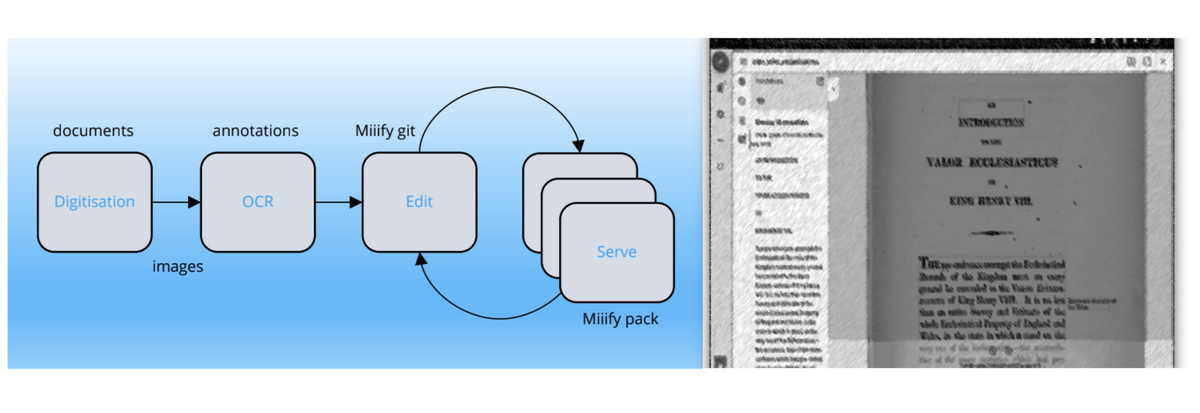
<p>In a thought-provoking presentation, John Moore (National Archives, UK) explored how the choice of technology can impact the digital footprint of a IIIF-related digital service, specifically <a href="https://github.com/nationalarchives/miiify">Miiify</a>, in terms of extracting annotation data from OCR at scale. Miiify Git stores annotations as text files in a format that is easy to edit manually or by another client, with each annotation being a single file. However, there is a performance cost. Miiify pack follows the principles of distributed working in Git and is used within the Tezos blockchain. The environmental impact of this is significant, with 100 iterations of Git write equating to 405.85g of CO2e, 1.76 KWh, or 2.32 km in a passenger car (<a href="http://calculator.green-algorithms.org/">according to this calculator</a>). Future work includes modifying existing IIIF viewers to support annotation edit for Git backend, implementing Miiify on MirageOS, and conducting workshops on annotations.</p>

<p><img src="https://julsraemy.ch/assets/images/9dffc645047ee7955cb068cda584744b.png" alt="9dffc645047ee7955cb068cda584744b.png" /></p>

<h3 id="kompakkt">Kompakkt</h3>

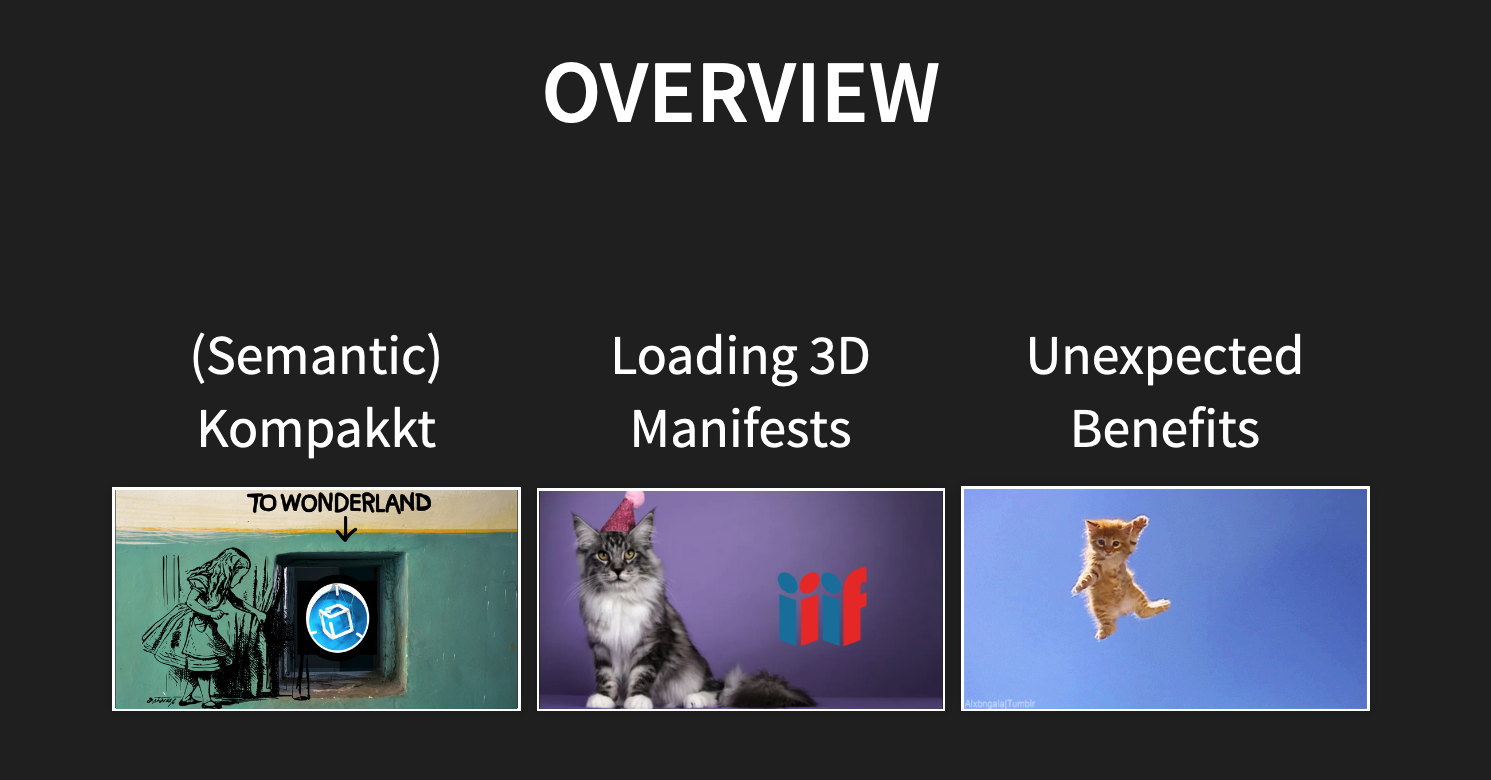
<p>Zoë Schubert (Staatsbibliothek Berlin) presented on <a href="https://zetoe.github.io/Talk-IIIF-Annual-Conference-3DManifest-Kompakkt/">3D Manifest with Kompakkt in Babylon.js</a>, sharing lessons learned and challenges faced. The presentation included some delightful GIFs of cats. Key takeaways included the importance of deeply understanding their own code, rethinking past decisions, seeking user feedback to support their needs, and relying on the IIIF 3D Technical Specification Group (TSG) experts for support on all aspects of the manifestos.</p>

<p><img src="https://julsraemy.ch/assets/images/kompakkt.png" alt="" /></p>

<h3 id="analytical-support-tools-for-historical-drawing-maps">Analytical Support Tools for Historical Drawing Maps</h3>

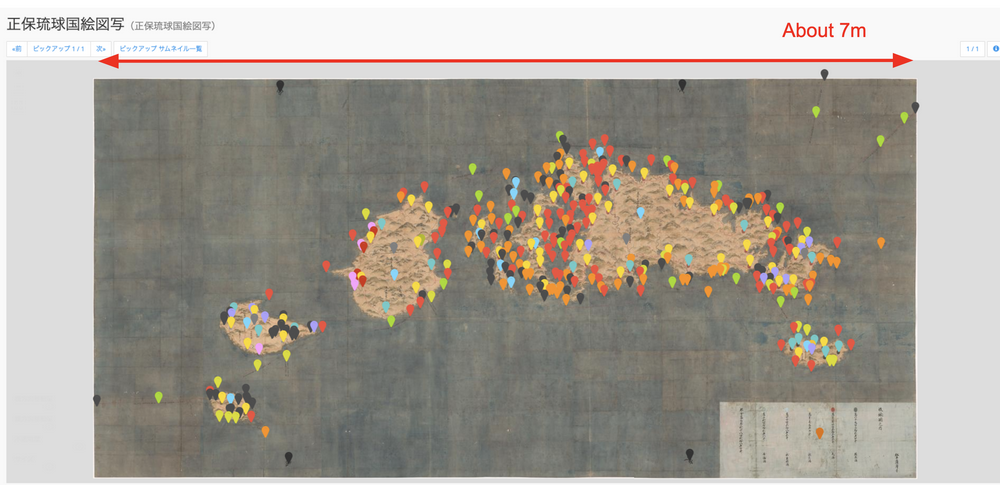
<p>Satoru Nakamura and Taizo Yamada from the University of Tokyo presented their innovative work on the IIIF Georeference extension and a specialized Mirador plugin designed for analyzing historical drawing maps. Their presentation highlighted the development of tools aimed at enhancing the visualization and comparison of historical maps through georeferencing.</p>

<p>One of the key tools they developed is a set of <a href="https://github.com/nakamura196/iiif_geo">visualization tools compliant with the IIIF Georeference Extension</a>. These tools facilitate the analysis of historical maps by integrating georeference data, making it easier to visualize the maps in a geographically accurate context. Additionally, they created <a href="https://github.com/nakamura196/mirador-compare-plugin">Mirador 3 plugins for comparing annotations</a>, which allow users to compare annotations across different maps, providing a powerful tool for historians and researchers.</p>

<p><img src="https://julsraemy.ch/assets/images/c8f0c6f24a0506d904ecb2ecebb60853.png" alt="c8f0c6f24a0506d904ecb2ecebb60853.png" /></p>

<p>A significant enhancement introduced in their work is a property called <code class="language-plaintext highlighter-rouge">cid</code>, which extends the IIIF specification. This addition allows for more detailed and precise annotations. Moreover, they have implemented a feature that enables users to rotate an image to any arbitrary angle, offering greater flexibility in analyzing map orientations and features.</p>

<p>Looking ahead, Nakamura and Yamada plan to further develop the visualization tools to include features such as alignment using points other than markers, which will improve the accuracy and usability of the georeference tools. They also aim to update the plugin to ensure compatibility with Mirador 4, keeping their tools in line with the latest version of the platform. Additionally, they seek to enhance interactions with aggregated IIIF Manifests on <a href="https://cultural.jp/">Cultural Japan</a>, aiming to provide a richer and more integrated user experience for those exploring Japan’s cultural heritage through historical maps.</p>

<h3 id="serverless-iiif">Serverless-IIIF</h3>

<p>Karen Shaw from Northwestern University Libraries delivered an interesting presentation titled, “Watch me spin up a production-ready, lightning-fast, IIIF image service in less time than it takes to give this talk.”</p>

<p>She showcased <a href="https://github.com/samvera/serverless-iiif">Serverless-IIIF</a>, a project within the Samvera community <a href="https://aws.amazon.com/blogs/publicsector/northwestern-university-libraries-make-research-more-efficient-accessible-with-aws-lambda/">that requires an AWS account for deployment</a>. Karen outlined the three different installation paths available, each with specific configurations needed, such as providing the source buckets for the images to be served. This flexibility ensures that users can choose the path that best fits their needs and resources.</p>

<p>The service supports both Version 2 and Version 3 IIIF Manifests. To demonstrate the scalability and performance of the server, Karen leveraged Glen Robson’s <a href="https://github.com/glenrobson/iiif-loadtest">loadtest</a> tool and <a href="https://locust.io/">Locust</a> to perform comprehensive scalability tests. The results highlighted the efficiency of the serverless IIIF image service.</p>

<h3 id="turning-patterned-fabrics-into-sound-to-make-archival-collections-more-accessible">Turning Patterned Fabrics into Sound to Make Archival Collections More Accessible.</h3>

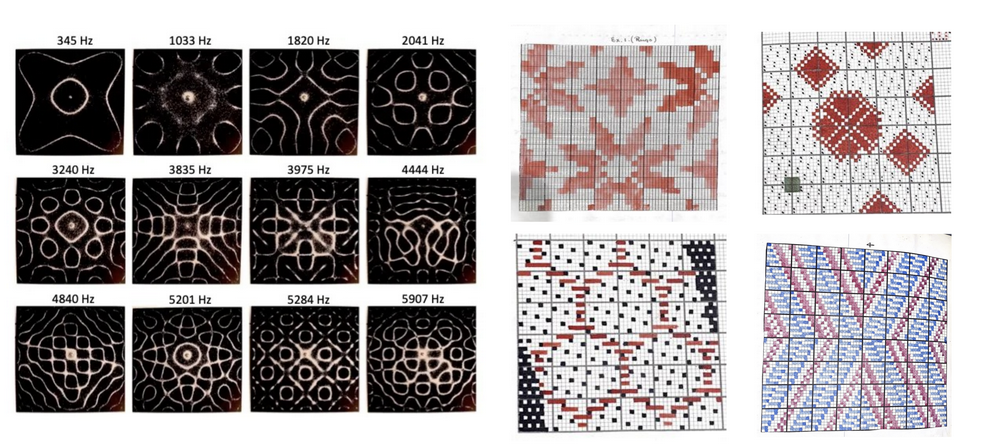
<p>Maia Mackay from the University of Leeds delivered a fascinating presentation on transforming textiles into sound using IIIF, a project spearheaded by the <a href="https://dcch.leeds.ac.uk/">Digital Creativity and Cultures Hub (DCCH)</a>. This innovative initiative involves 19th-century project books from the Yorkshire College, now part of the university, which delve into the intricate process of weaving. For those interested in experiencing cymatic patterns through sound, you can listen to them on <a href="https://youtu.be/ltJKDvXLmlg?si=b_uTSjXnuLLLKomV&amp;t=2181">YouTube at 36:21</a> from the second video of the first day.</p>

<p><img src="https://julsraemy.ch/assets/images/413ea084bdd222ba0ab03c33000c04ca.png" alt="413ea084bdd222ba0ab03c33000c04ca.png" /></p>

<p>Maia highlighted several critical ways IIIF facilitated the project. The deep zoom features of IIIF are crucial for digitally conveying the intricate textures of woven fabrics. The ability to zoom in on the fine details enhances the viewer’s appreciation and understanding of the textile’s complexity. Additionally, the clarity of the audio resources is paramount to the immersive experience the project aims to provide. IIIF’s capabilities ensure that the auditory representation maintains its authenticity and clarity. By combining these features, IIIF supports a unique relationship between visual and auditory representations of the fabrics. This dual-sensory portrayal enriches the accessibility and engagement with the archival collections, making them more accessible to a wider audience.</p>

<h3 id="booksnake">Booksnake</h3>

<p>Sean Fraga gave a presentation on <a href="https://booksnake.app/">Booksnake</a>, an iOS-based scholarly application developed at the University of Southern California. This innovative app automatically transforms existing IIIF-compliant resources into life-size virtual objects for interaction in physical space, enhancing the way users engage with digital content. Booksnake allows users to download item images and metadata through IIIF, creating an immersive augmented reality experience. The app has been tested in classrooms to evaluate whether interacting with archival materials in augmented reality affects student learning outcomes compared to traditional web-based viewers.</p>

<p>The results from these tests are promising. Quantitative feedback indicates that Booksnake received better reviews across all four measures: Attention, Relevance, Confidence, and Satisfaction. Qualitative feedback from users highlighted several benefits, such as the ability to get really close to the source material, the focus on one image at a time allowing for detailed examination, and the sensation of seeing the real thing up close adding to the experience.</p>

<p>Sean also shared best practices for using Booksnake. He emphasized choosing embodied activities to fully leverage the app’s capabilities, showing rather than telling to let the interaction speak for itself, planning for inclusion to ensure accessibility for all users, and making room for virtual materials by integrating them seamlessly into the learning environment. Booksnake is available for both iPhone and iPad, with the source code set to be released soon. Currently, the materials used are from the Library of Congress.</p>

<h3 id="detektiiif-3">DetektIIIF 3</h3>

<p>The third version of <a href="https://seige.digital/en/detektiiif/">DetektIIIF</a>, a browser extension for Google Chrome and Firefox capable of identifying IIIF resources on webpages, was presented by its creator, Leander Seige. Originally, DetektIIIF was designed to uncover hidden links to IIIF Manifests, addressing the challenges that IIIF poses for non-technical users.</p>

<p>DetektIIIF offers several basic features. It shows the number of found resources and performs quality checks, displaying a warning if no HTTPS is available or if the ID does not match the URI. Additionally, it provides small tools for tasks such as the creation of collections, making it a handy utility for IIIF users.</p>

<p>Version 3 of DetektIIIF, published in early June, includes new enhancements such as Mirador4 embedded and real-time synchronization via Browser Sync Storage. The extension is currently available in the Chrome Web Store and will soon be available for Firefox. The <a href="https://github.com/seigedigital/detektiiif3">source code</a> has also been published, allowing developers to contribute and customize the tool further.</p>

<h3 id="canvas-panel">Canvas Panel</h3>

<p><a href="https://github.com/digirati-co-uk/iiif-canvas-panel">Canvas Panel</a> is a web component developed by Digirati and presented by Tom Crane for this occasion. It functions similarly to how OpenSeadragon works with an image service, but Canvas Panel is designed to handle a IIIF Canvas. This allows for a much richer experience as canvases can include a variety of media types, such as images, audio, and video.</p>

<p>Here is a very basic example:</p>

<div class="language-plaintext highlighter-rouge"><div class="highlight"><pre class="highlight"><code>&lt;canvas-panel  
 canvas-id="https://digirati-co-uk.github.io/wunder/canvases/0" 
 manifest-id="https://digirati-co-uk.github.io/wunder.json"&gt;  
&lt;/canvas-panel&gt;`Tag
</code></pre></div></div>
<p>Canvas Panel offers a range of capabilities. In its simplest form, with no additional attributes, it functions like OpenSeadragon and Leaflet by rendering a viewport where the canvas or a zoomed-in part of it is visible. The component is optimized to be responsive, making image requests that are appropriate to its size on the page, ensuring efficient loading and rendering. Additionally, Canvas Panel supports the display of specific regions of the canvas, enhancing the focus on particular sections.</p>

<p>Accessibility is also a key feature of Canvas Panel. It uses media queries to determine how requests to the IIIF Image API are made, ensuring that the component adapts to different viewing environments and devices, providing an inclusive experience for all users.</p>

<h3 id="arvest">Arvest</h3>

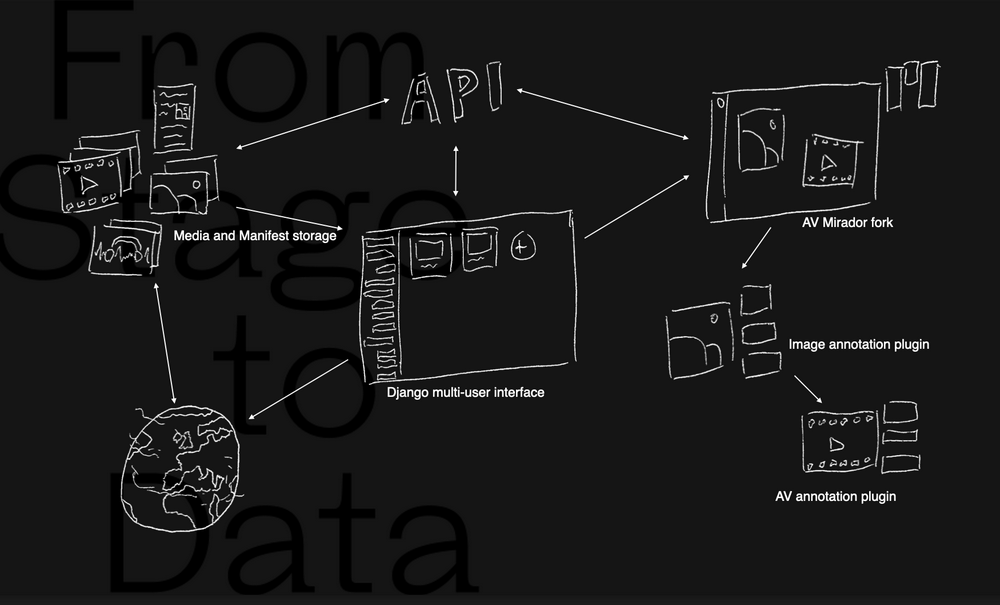
<p>Jacob Hart from Université Rennes 2 presented <a href="https://arvest.gitpages.huma-num.fr/links">Arvest</a>, a tool developed by Tetras Libre for the analysis and navigation of collections of digital documents. Arvest functions as a virtual desktop, catering to two user profiles: historians and analysts.</p>

<p>The prototype includes a video annotation application based on Mirador which operates in a multi-user environment built in Django. This environment is designed to be user-friendly and supports storage through PeerTube, making it accessible and versatile. Arvest supports various annotation types with a plugin for the latest version of Mirador, targeting image, video, and audio content. It also allows for time-linked annotations for time-based media, enhancing the depth of analysis possible within the platform.</p>

<p><img src="https://julsraemy.ch/assets/images/1232fea239008b5ebbc9c80770494507.png" alt="1232fea239008b5ebbc9c80770494507.png" /></p>

<p>The project includes three major case studies. COESO focuses on contemporary dance and citizen science, utilizing close reading, distant reading, network analysis, and collaboration. Art Zoyd pertains to electroacoustic music, preservation, and music analysis, emphasising content discovery and music information retrieval. Plozévet involves history, anthropology, and sociology, using computer vision, network analysis, close reading, and distant reading.</p>

<p>A beta version of Arvest is expected to be released around December 2024, with an AV annotation plugin anticipated by October 2024.</p>

<h3 id="the-feminist-art-of-integration-judy-chicagos-archives-and-iiif">The (Feminist) Art of Integration: Judy Chicago’s Archives and IIIF</h3>

<p>Dominique Luster from the Pennsylvania State University Libraries presented on ‘The (Feminist) Art of Integration: Judy Chicago’s Archives and IIIF’.</p>

<p>The vision of the <a href="https://judychicagoportal.org/">Judy Chicago Portal</a> is to increase online access and pathways to most of Judy Chicago’s collection. Visitors to the portal can view a broader selection of materials, explore pedagogical and creative projects, and engage with a larger community of researchers. Additionally, the portal aims to identify potential areas for collaboration and thematic linking across repositories, emphasizing the impact of Judy’s work and feminist practice.</p>

<p>The project is divided into three phases:</p>

<ol>
  <li><strong>Groundwork</strong>: The initial phase involved creating a website that articulated the project’s intent, purpose, and vision. This site featured a small sample of items with links back to the respective repositories and institutions. During this phase, a collaboration site was established while work on the main portal commenced, initially showcasing 50 items from the founding three institutions.</li>
  <li><strong>IIIF Integration</strong>: In the second phase, the team surveyed other portals to identify best practices. They planned to organize the works by project, theme, and format, developing a simple common schema based on Dublin Core. Collaborating with partners, they implemented IIIF protocol for thumbnail images, ensuring no images were stored on the portal but were pulled from the home institution’s repository. This phase also involved designing the site architecture and user interface, followed by user testing with researchers and graduate students at each partner institution.</li>
  <li><strong>Expansion and Optimization</strong>: The final phase focuses on adding all available records, revising the metadata schema, and conducting further user experience testing and redesign. Additionally, the team is implementing social media and awareness campaigns to increase engagement and visibility.</li>
</ol>

<p>The project faced challenges due to the varying scales and schedules of the five partners. These challenges included differences in the extent of participation, varying sizes of collections, folder versus item-level records, and the need for metadata alignment across different standards.</p>

<h3 id="maktaba">Maktaba</h3>

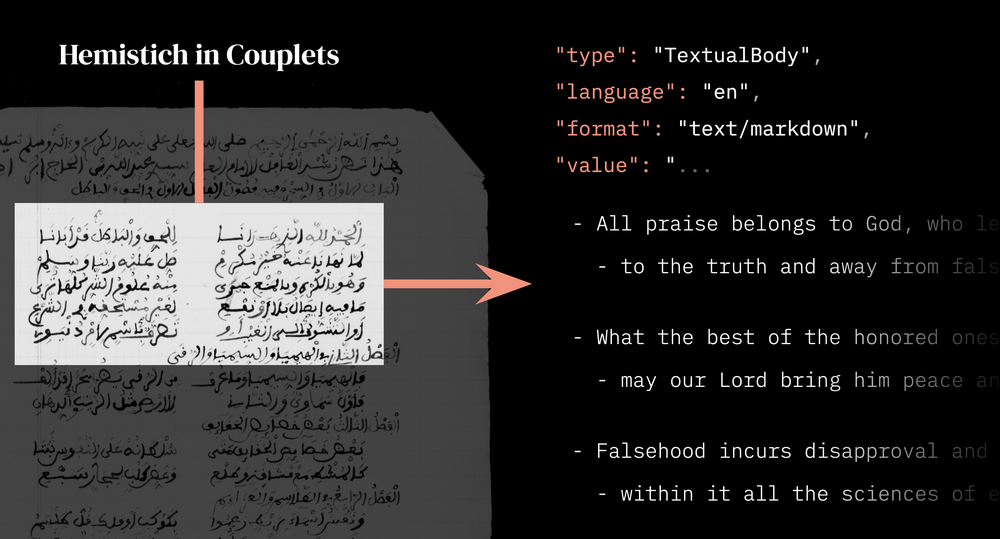
<p><a href="https://isita.northwestern.edu/research/neh-award-supports-development-of-digital-manuscript-collection.html">Maktaba</a> is a project from the University of Illinois and the Northwestern University Libraries, focusing on valuable collections of manuscripts from the 19th through the early 20th centuries that represent the Islamic tradition in West Africa. David Schoeber and Mat Jordan from Northwestern University Libraries presented this project, highlighting that their libraries host over 7,000 works in prose and verse written by African Muslims in Arabic and in ‘ajami, African languages written in an adapted Arabic alphabet.</p>

<p>The project utilizes IIIF to offer robust solutions for manuscript preservation and access:</p>
<ul>
  <li><strong>Manifests are extendable</strong>, allowing for comprehensive metadata and resource descriptions.</li>
  <li><strong>Collections unify manifests</strong>, providing a cohesive view of related works.</li>
  <li><strong>Annotations represent transcriptions and translations</strong> on Canvases, making the content accessible and understandable.</li>
  <li><strong>Language and internationalization support</strong> ensures that the content can be viewed and understood globally.</li>
  <li><strong>Viewers and tooling are readily available</strong>, facilitating easy access and interaction with the manuscripts.</li>
  <li><strong>Reuse and remix capabilities</strong> enable further scholarly and educational use of the materials.</li>
</ul>

<p><img src="https://julsraemy.ch/assets/images/ffe4e0ac42bf7f420954b023c2b5a856.png" alt="ffe4e0ac42bf7f420954b023c2b5a856.png" /></p>

<p>The Maktaba Collection is organised as an IIIF Collection, with <a href="https://canopy-iiif.vercel.app/">Canopy IIIF</a> used to generate a static site. Essays are included as Markdown files, providing contextual information and scholarly insights.</p>

<p>IIIF is seen as the backbone of this project, creating lightweight yet powerful applications that enhance the accessibility and usability of these invaluable manuscripts.</p>

<h3 id="presentation-plus">Presentation Plus</h3>

<p>‘Presentation Plus: Working at the Edges of the Presentation API’ was presented by Dan Brennan of the J. Paul Getty Trust. Dan discussed the creation of an image viewer designed to meet some specific needs at the Getty.</p>

<p>One notable project highlighted was the <a href="https://www.getty.edu/art/collection/object/1040J2">Dessins photographiques sur Papier. Recueil No. 2</a>, also known as the Bayard Album, which contains early photography experiments. This album passed through many hands before being acquired by Getty in the 1980s and subsequently disassembled for conservation purposes.</p>

<p>Dan explained that while the Bayard Album project is technically feasible with IIIF, it has not progressed much beyond the initial Châteauroux Demo. A <a href="https://data.getty.edu/media/manifest/bayard-custom">custom Manifest</a> was created for this project. They employed a method involving a CSV of metadata combined with Python scripts to generate the JSON-LD file, but automating the annotation placement and scaling across 200 Canvases proved challenging.</p>

<p>Several tools were used in the process:</p>
<ul>
  <li><strong>Digirati’s Manifest Editor</strong>: This <a href="https://manifest-editor.digirati.services/">tool</a> was helpful, but its interface is not yet novice-friendly, and handling large Manifests can be cumbersome.</li>
  <li><strong>Canvas Panel</strong>: Provided foundational web components for building a canvas-centric viewer that met the project’s requirements, though there was still a need to build a custom viewer.</li>
</ul>

<p>A significant amount of work has been done, but Dan Brennan noted that the project remains highly specialised. The <a href="https://iiif.io/api/cookbook/recipe/">IIIF Cookbook Recipes</a> were invaluable resources throughout the process. Building a viewer posed numerous challenges, prompting philosophical questions about the nature of the digital representation compared to the physical object.</p>

<p>In conclusion, while the project showcased the potential of IIIF, it also highlighted the complexities involved in creating customized digital solutions for unique archival materials.</p>

<h3 id="iiif-and-the-global-south-reaching-out-to-the-ununderrepresented">IIIF and the Global South: Reaching out to the Un/Underrepresented</h3>

<p>Sonaj Kasail from Université Bourgogne Franche-Comté shared valuable insights on the implementation of IIIF in the Global South, with a particular focus on India.</p>

<p>Kasail highlighted the <a href="https://www.bnf.fr/en/shared-heritage">BnF Shared Heritage initiative</a>, specifically the “France - South Asia” digital library, which documents the history of representations and relations between France and countries in South Asia, including India, Bangladesh, Nepal, Sri Lanka, and Pakistan. Notably, none of the partner institutions in South Asia currently implement IIIF.</p>

<p>Regarding IIIF implementation in India, Kasail mentioned two significant projects:</p>

<ul>
  <li><strong><a href="https://samhita.iicdelhi.in/">SAMHiTA</a></strong>: An initiative to create a relational database and digital archive of Indian and broadly South Asian manuscripts housed in libraries, archives, and other repositories outside India.</li>
  <li><strong><a href="https://archives.ncbs.res.in/home">Archives at NCBS</a></strong>: A public center for the history of science in contemporary India, housing over 250,000 processed objects across 30+ collections, including manuscripts, photographs, fine art, audio recordings, scientific equipment, letters, and field and lab notes.</li>
</ul>

<p>Kasail proposed several solutions to improve IIIF outreach and adoption in the Global South:</p>

<ul>
  <li><strong>Enhanced Outreach</strong>: Extend IIIF outreach to regions historically overlooked, including the Global South and other underrepresented areas.</li>
  <li><strong>Collaborative Opportunities</strong>: Identify potential collaborations with institutions in these regions and encourage them to join the IIIF Consortium.</li>
  <li><strong>Presence at Events</strong>: Increase IIIF’s presence at relevant conferences, meetings, and other events to raise awareness.</li>
  <li><strong>Promotion Across Sectors</strong>: Advocate for the adoption of IIIF across both public and private organizations.</li>
  <li><strong>IIIF Ambassadors</strong>: Appoint ambassadors to promote IIIF in countries of the Global South.</li>
  <li><strong>Strategic Inclusion</strong>: Integrate global outreach within IIIF’s strategic framework and advocacy efforts.</li>
  <li><strong>Localized Outreach</strong>: Tailor outreach initiatives to be culturally sensitive and accessible to communities in the Global South.</li>
  <li><strong>Capacity Building</strong>: Host workshops and training sessions focused on IIIF adoption and implementation in these regions.</li>
  <li><strong>Regional Partnerships</strong>: Forge partnerships with regional organizations, consortia, and networks to facilitate knowledge sharing and collaboration.</li>
  <li><strong>Funding Opportunities</strong>: Provide scholarships, grants, and funding opportunities to support participation from researchers, practitioners, and institutions in the Global South.</li>
  <li><strong>Mentorship Programs</strong>: Establish mentorship programs pairing experienced IIIF practitioners with individuals and institutions in the Global South.</li>
  <li><strong>Representation and Recognition</strong>: Ensure voices from the Global South are represented within the IIIF community, recognizing their unique contributions and perspectives.</li>
</ul>

<p>Kasail’s presentation underscored the importance of inclusive and equitable access to digital archival resources, and the potential of IIIF to bridge gaps and foster global collaboration.</p>

<h3 id="aiml-tags-in-iiif-manifests">AI/ML Tags in IIIF Manifests</h3>

<p>Allison Kelly Sherrick from the Metropolitan New York Library Council presented on creating a better balance and the respectful reuse of AI/ML tags in IIIF Manifests. She proposed the implementation of standardized “no AI” or “regulated AI” tags to govern the use of AI and machine learning on IIIF resources:</p>

<ul>
  <li><strong>No AI</strong>: No image or textual ML/AI at all.</li>
  <li><strong>No Image AI</strong>: No image-based ML/AI, but textual (metadata, OCR, transcript) use is allowed.</li>
  <li><strong>Regulated AI</strong>:
    <ul>
      <li>ML/AI Use Permitted - with attribution.</li>
      <li>ML/AI Use Permitted - with express written consent and attribution.</li>
    </ul>
  </li>
</ul>

<p>Sherrick illustrated her points with the parable of a flower. She noted that the average ML/AI operations of major tech companies consume as much water annually as 4-6 small European or African countries, each with a population of around 5 million.</p>

<p><img src="https://julsraemy.ch/assets/images/flower.png" alt="cca7c8b808e62048fd3f7f0e36851245.png" /></p>

<p>She argued that many cultural heritage community members are metaphorically holding their “flowers” and proposed that the IIIF community should leverage these tags to limit the scraping of images and text.</p>

<p>Key points from her presentation included:</p>
<ul>
  <li>While IIIF is an API-based framework geared towards machine-mediated interactions, its resources are ultimately for human use.</li>
  <li>The use of standardized “no AI” or “regulated AI” tags in IIIF Manifests must be paired with sophisticated, up-to-date DevOps and data security practices.</li>
  <li>As institutions decide to use or integrate ML/AI tools into their repositories, they must consider their curatorial legacies and the complex nature of their content.</li>
  <li>It’s crucial to monitor new and evolving ML/AI lawsuits and government regulations worldwide.</li>
  <li>This technology will continue to evolve, requiring diligent application and monitoring for the foreseeable future.</li>
</ul>

<p>Sherrick’s presentation underscored the importance of balancing technological advancements with respect for cultural heritage and ethical considerations in the use of AI and machine learning.</p>

<h3 id="connecting-iiif-and-semantic-cultural-heritage-metadata-for-discovery">Connecting IIIF and Semantic Cultural Heritage Metadata for Discovery</h3>

<p>The only birds of a feather session I attended is the one I co-organised with Rob Sanderson (Yale), Kevin Page (Oxford), Daniel Sissman (Getty), Claire Knowles (University of Leeds), and Tom Crane (Digirati) on <a href="https://docs.google.com/presentation/d/1bVDBglM_Sd0cTubNCamnPCpsFg7IwvMg/edit?pli=1#slide=id.g2e2512dee13_2_12">connecting IIIF and semantic cultural heritage metadata for discovery</a>, and most specifically <a href="https://linked.art">Linked Art</a>, a Linked Open Usable Data (LOUD) specification and community.</p>

<p>Many core use cases for IIIF extend beyond images and their presentation, delving into the digitised cultural heritage resources themselves. There is a longstanding desire to discover IIIF-accessible resources by searching the properties and relationships of real-world objects, such as creators, subjects, classifications, or dates. This session explored how organizations are leveraging the Linked Art specification alongside IIIF to realize significant benefits through the joint adoption of these highly usable standards.</p>

<p>Over the past five years, Linked Art has been meticulously designed and implemented, drawing from and intentionally aligning with the community best practices and design principles that IIIF has exemplified. Linked Art uses an existing, standard conceptual model and encodes knowledge using shared patterns in JSON-LD, made accessible via an easy-to-publish and consume web API. This specification has gained international adoption among cultural heritage research and collecting institutions. During our session, we discussed implementation experiences, available tools, and strategies for maintaining and enriching the connection between these overlapping communities and specifications.</p>

<p>Both Linked Art API endpoints and IIIF APIs adhere to similar patterns, offering seamless integration. Key lessons from IIIF include:</p>
<ul>
  <li>Emphasis on JSON-LD semantics.</li>
  <li>Simplified property names for usability.</li>
  <li>Consistent structure.</li>
  <li>Use of GET for easy caching.</li>
  <li>Sensible partitioning of responses based on usage.</li>
  <li>No stringent URI structure requirements (as seen in IIIF Presentation API).</li>
  <li>Activity Stream-based format for non-semantic APIs (such as Discovery, Content Search, and Annotation Pages).</li>
</ul>

<p>As a thought-provoking suggestion, Rob Sanderson proposed that:</p>

<p><em>Linked Art is the solution to the “discovery challenge” of IIIF. It can describe and connect resources across all cultural and natural heritage domains, is abstract enough to accommodate future domains, and is usable enough to be widely implemented: IIIF should adopt Linked Art as a new TSG and Specification:</em>.</p>

<h3 id="conclusion">Conclusion</h3>

<p>I am very happy to have attended this conference, generously supported by the <a href="https://www.dasch.swiss/">Swiss National Data and Service Center for the Humanities</a> (DaSCH), where I have been working since June 2021. Representing DaSCH on the IIIF Technical Review Committee has been a rewarding experience, and I am grateful for their support. As I transition to working solely at the <a href="https://www.bar.admin.ch">Swiss Federal Archives</a> at the end of October 2024, I extend my heartfelt thanks to DaSCH.</p>

<p>I am also thankful to my current employer, the Swiss Federal Archives, for allowing me to attend this conference. I will continue being actively involved in the IIIF community for several reasons: I love this community and the learning and networking opportunities it provides, the Swiss Federal Archives have implemented IIIF, and I will continue to serve on the Coordinating Committee (CoCo).</p>

<p>I hope to be at next year’s conference in Leeds, and who knows, perhaps the Swiss Federal Archives will become part of the IIIF Consortium as well! :wink: I truly believe in this initiative, as it has been crucial in my studies (from my bachelor’s degree to <a href="https://phd.julsraemy.ch">my PhD</a>), work, and also personal life with the friends I met along the way.</p>]]></content><author><name>Julien A. Raemy</name></author><category term="posts" /><category term="3D" /><category term="API" /><category term="Community" /><category term="Cultural Heritage" /><category term="LOUD" /><category term="IIIF" /><category term="Linked Art" /><summary type="html"><![CDATA[A post summarising some notes I took from the 2024 International Image Interoperability Framework (IIIF) Annual Conference held in Los Angeles, CA, USA (June 4-7, 2024).]]></summary></entry><entry><title type="html">PhD Website: LOUD for Cultural Heritage – now running with 11ty</title><link href="https://julsraemy.ch/posts/2024/02/22/phd-website-loud-11ty/" rel="alternate" type="text/html" title="PhD Website: LOUD for Cultural Heritage – now running with 11ty" /><published>2024-02-22T12:50:28+01:00</published><updated>2024-02-22T12:50:28+01:00</updated><id>https://julsraemy.ch/posts/2024/02/22/phd-website-loud-11ty</id><content type="html" xml:base="https://julsraemy.ch/posts/2024/02/22/phd-website-loud-11ty/"><![CDATA[<h2 id="redesigning-the-phd-website-with-11ty">Redesigning the PhD Website with 11ty</h2>

<p>The choice of technology platforms for presenting research can have a profound impact on the accessibility and engagement of scholarly work. For my PhD - <a href="https://phd.julsraemy.ch">Linked Open Usable Data for Cultural Heritage</a> - I embarked on a journey to rethink how my research could be presented online. The result is a shift from using <a href="https://omeka.org/s/">Omeka S</a>, a popular choice in the cultural heritage sector, to adopting <a href="https://www.11ty.dev/">11ty</a>, a modern static site generator.</p>

<h3 id="why-moving-away-from-omeka-s">Why Moving Away from Omeka S?</h3>

<p>Omeka S, an open source publishing platform,  has been a staple in the GLAM (galleries, libraries, archives, and museums) sector for its robustness in handling digital exhibitions and collections. Initially, one of my goals was to have an application programming interface (API) alongside the user interface to facilitate access to the research data. Omeka S provides facilities for such integration, but as my project evolved I realised the potential and flexibility of generating JSON-LD, for potential Linked Art API endpoints, files statically. However, as the needs of my project evolved, I sought more flexibility and control over the presentation and management of my content. The need for a lightweight, customisable platform became obvious. The focus shifted to creating a more flexible, efficient and straightforward solution that could still meet the project’s goals without the overhead of maintaining a server-side API.</p>

<h3 id="the-appeal-of-11ty">The Appeal of 11ty</h3>

<p>The decision to use Eleventy (11ty) as the basis for my PhD website was driven by its simplicity, speed and flexibility. 11ty stands out for its minimalist approach to static site creation, prioritising performance and developer experience. Unlike traditional content management systems, which often come with a steep learning curve and bloated features, 11ty offers a streamlined, straightforward development process. One of the key advantages of 11ty is its flexibility in handling different types of input files - Markdown, HTML, Nunjucks and more - allowing for a highly adaptable content structure.</p>

<p>11ty’s build process is fairly efficient, resulting in fast-loading pages that improve site accessibility and user engagement. Its support for modern web development practices, including seamless integration with various front-end tools and pre-processors.</p>

<h3 id="hosting-the-phd-thesis-as-html">Hosting the PhD Thesis as HTML</h3>

<p>One of the main motivations for this technological pivot was the desire to host <a href="https://phd.julsraemy.ch/thesis.html">my thesis as HTML on the site</a> - which will hopefully be accessible by 2025, as this facilitates the integration of multimedia elements, interactive visualisations and direct links to digital artefacts and datasets, such as embedding IIIF resources in compatible viewers.</p>

<h3 id="around-the-phd">Around the PhD</h3>

<p>The redesigned website also serves as a platform to highlight the broader aspects of my research, including the concept of <a href="https://phd.julsraemy.ch/loud.html">Linked Open Usable Data (LOUD)</a>, the related <a href="https://phd.julsraemy.ch/research.html">research outcomes</a>, as well as the <a href="https://phd.julsraemy.ch/pia.html">PIA research project</a>.</p>]]></content><author><name>Julien A. Raemy</name></author><category term="posts" /><category term="PhD" /><category term="Cultural Heritage" /><category term="LOUD" /><category term="IIIF" /><category term="Linked Art" /><category term="11ty" /><category term="Omeka S" /><summary type="html"><![CDATA[I have redesigned my PhD Website – Linked Open Usable Data for Cultural Heritage (https://phd.julsraemy.ch) – with 11ty, a static site generator, instead of Omeka S.]]></summary></entry><entry><title type="html">Being (correctly) cited</title><link href="https://julsraemy.ch/posts/2023/07/03/being-correctly-cited/" rel="alternate" type="text/html" title="Being (correctly) cited" /><published>2023-07-03T11:25:42+02:00</published><updated>2023-07-03T11:25:42+02:00</updated><id>https://julsraemy.ch/posts/2023/07/03/being-correctly-cited</id><content type="html" xml:base="https://julsraemy.ch/posts/2023/07/03/being-correctly-cited/"><![CDATA[<h2 id="being-correctly-cited">Being (correctly) cited</h2>

<p>Being cited as a young academic is both exciting and gratifying. It’s an acknowledgment that my work is making some impact and I’ve been actually cited a couple of times over the past few months.</p>

<p>However, as someone who is still building my academic profile, I’m always keen to understand how my work has been cited and how others have engaged with it. It’s important to recognise that citations are not just about numbers; they provide insights into how one’s research is perceived and used by others.</p>

<p>While it’s encouraging to be cited, I’ve come across a couple of instances where the citations were not entirely accurate. In some cases, the information was not properly represented, either in terms of its form or its content. I reckon that it can happen for various reasons, such as misunderstandings or unintentional errors.</p>

<p>If the inaccuracies significantly undermine understanding or presentation of what I have written, I need to consider writing a respectful response or correction, and that is why I am writing this blog post.</p>

<h3 id="type-of-paperthesis">Type of paper/thesis</h3>

<p>In this journal article by Branco et al. titled “Agents Based Cyber-Physical Diffused Museums Over Web Interoperability Standards”<sup id="fnref:1" role="doc-noteref"><a href="#fn:1" class="footnote" rel="footnote">1</a></sup>, on the PDF version, I realised that my bachelor’s thesis<sup id="fnref:2" role="doc-noteref"><a href="#fn:2" class="footnote" rel="footnote">2</a></sup> has been cited as a PhD thesis. Well, you can call me Dr.</p>

<p>Of course, this makes me smile and it will be another (at least) two years before I can say I’ve written a PhD thesis.</p>

<h3 id="conjunctions">Conjunction(s)</h3>

<p>On page 22 of Pitta’s master’s thesis<sup id="fnref:3" role="doc-noteref"><a href="#fn:3" class="footnote" rel="footnote">3</a></sup>, she wrotes the following:</p>

<blockquote>
  <p>The IIIF presentation API only works in combination with the Image API, since in order to implement the IIIF presentation API, institutions must implement the Image API (Raemy, 2020, p.37). Raemy confirms this since he found that all the institutions that implemented the IIIF presentation API also had implemented the Image API (Raemy, 2020, p.37).</p>
</blockquote>

<p>Although I can confirm that in the survey I carried out for Europeana as part of my master’s thesis<sup id="fnref:4" role="doc-noteref"><a href="#fn:4" class="footnote" rel="footnote">4</a></sup>, all the survey participants that mention an implementation of the <a href="https://iiif.io/api/presentation">IIIF Presentation API</a> have also implemented the <a href="https://iiif.io/api/image">IIIF Image API</a>, it is absolutely not compulsory to implement the IIIF Image API in order to have resources (Manifests/Collections) that are compatible with the IIIF Presentation API.</p>

<p>This is what I said on page 37:</p>

<blockquote>
  <p>As for the implementation, the IIIF Image API is the most deployed specification among the participants (11 occurrences: 21.2%), followed by the IIIF Presentation API (10: 19.2%) and the IIIF Content Search API (once). All institutions that have deployed the IIIF Presentation API have also deployed the IIIF Image API (both APIs are often referred to as the “IIIF core APIs”), which is expected since the latter works in conjunction with the former.</p>
</blockquote>

<p>For instance, static images or audiovisual resources (since version 3 of the IIIF Presentation API) can be painted onto a Canvas. So I’m indeed talking about a conjunction in the sense of ease of implementation. The IIIF Editors say it better as it is one of the <a href="https://iiif.io/api/annex/notes/design_principles/">IIIF Design Principles</a> called “2.11. Separate Concerns, Loosely Couple APIs”:</p>

<blockquote>
  <p>In the well established principle of doing one thing well, IIIF specifications should address their own area of concern and be loosely coupled rather than tightly bound together. This allows for independent implementation and tooling, and simplifies the process for deployment by adopters and API updates by the community. For example, it is possible to implement the Image API without the Presentation API and vice versa. A counter example is that the Search API is necessarily more tightly linked to the Presentation API.</p>
</blockquote>

<p>Anyway, I just wanted to point out that you can implement either or both APIs, even if as a IIIF advocate, I agree that implementing both core APIs is convenient and a well-established practice in the cultural heritage field.</p>

<div class="footnotes" role="doc-endnotes">
  <ol>
    <li id="fn:1" role="doc-endnote">
      <p>Branco, D., Amato, A., Venticinque, S., &amp; Aversa, R. (2023). Agents Based Cyber-Physical Diffused Museums Over Web Interoperability Standards. <em>IEEE Access, 11</em>, 44107–44122. <a href="https://doi.org/10.1109/ACCESS.2023.3272641">https://doi.org/10.1109/ACCESS.2023.3272641</a> <a href="#fnref:1" class="reversefootnote" role="doc-backlink">&#8617;</a></p>
    </li>
    <li id="fn:2" role="doc-endnote">
      <p>Raemy, J. A. (2017). <em>The International Image Interoperability Framework (IIIF): Raising awareness of the user benefits for scholarly editions</em> [Bachelor’s thesis, Haute école de gestion de Genève]. <a href="https://sonar.ch/hesso/documents/314853">https://sonar.ch/hesso/documents/314853</a> <a href="#fnref:2" class="reversefootnote" role="doc-backlink">&#8617;</a></p>
    </li>
    <li id="fn:3" role="doc-endnote">
      <p>Pitta, C. P. C. (2023). <em>Implementing the International Image Interoperability Framework (IIIF) for accessibility and reuse of cultural heritage resources on the web – Challenges and Advantages</em> [Master’s thesis, Universidade NOVA de Lisboa]. <a href="http://hdl.handle.net/10362/154579">http://hdl.handle.net/10362/154579</a> <a href="#fnref:3" class="reversefootnote" role="doc-backlink">&#8617;</a></p>
    </li>
    <li id="fn:4" role="doc-endnote">
      <p>Raemy, J. A. (2020). <em>Enabling better aggregation and discovery of cultural heritage content for Europeana and its partner institutions</em> [Master’s thesis, HES-SO University of Applied Sciences and Arts, Haute école de gestion de Genève]. <a href="https://sonar.ch/hesso/documents/315109">https://sonar.ch/hesso/documents/315109</a> <a href="#fnref:4" class="reversefootnote" role="doc-backlink">&#8617;</a></p>
    </li>
  </ol>
</div>]]></content><author><name>Julien A. Raemy</name></author><category term="posts" /><category term="Citation" /><category term="Academia" /><category term="IIIF" /><summary type="html"><![CDATA[It's great being cited, it's better when people cite correctly. As a young academic, being cited is exciting and gratifying. It shows that my work is making an impact. While I appreciate the recognition, it's important to understand how my work is being cited and used by others. Sometimes, the citations are not entirely accurate, either in form or content, due to misunderstandings or unintentional errors. For example, in a journal article, my bachelor's thesis was mistakenly cited as a PhD thesis. Although it made me smile, I'm still two years away from earning a PhD. In another instance, a master's thesis claimed that the IIIF Presentation API can only be implemented alongside the Image API. However, it is not compulsory to implement the Image API to have resources compatible with the IIIF Presentation API. In a nutshell, I wanted to clarify these points and highlight that implementing either or both APIs is possible, although implementing both is often recommended for a comprehensive IIIF implementation.]]></summary></entry><entry><title type="html">DARIAH-CH Study Day - Back and Forth from Boundary Objects to IIIF Resources (Poster Script)</title><link href="https://julsraemy.ch/posts/2022/10/05/boundary-objects-iiif-dariah/" rel="alternate" type="text/html" title="DARIAH-CH Study Day - Back and Forth from Boundary Objects to IIIF Resources (Poster Script)" /><published>2022-10-05T13:00:42+02:00</published><updated>2022-10-05T13:00:42+02:00</updated><id>https://julsraemy.ch/posts/2022/10/05/boundary-objects-iiif-dariah</id><content type="html" xml:base="https://julsraemy.ch/posts/2022/10/05/boundary-objects-iiif-dariah/"><![CDATA[<h2 id="dariah-ch-study-day---poster-script">DARIAH-CH Study Day - Poster Script</h2>

<ul>
  <li>Title of the poster: <a href="https://doi.org/10.5281/zenodo.7015255"><em>Back and Forth from Boundary Objects to IIIF Resources. The Recipes of a Community-driven Initiative Specifying Standards</em></a></li>
  <li><a href="https://projectmirador.org/embed/?iiif-content=https://julsraemy.ch/hostiiing/manifests/backandforth.json">IIIF Manifest of the poster displayed on Mirador</a></li>
</ul>

<h3 id="submitted-abstract">(Submitted) Abstract</h3>

<p>The exchange of digital objects and their associated metadata is simplified when these meet established standards, but the capture of all the (meta)information is still very much in tension, at the limits of resources, knowledge and indeed the underlying capabilities of given standards. These limitations can be translated into what Susan Leigh Star defines as residual categories and consequently the generation of boundary objects. The question of these non-standardised residuals within the cultural heritage and digital humanities fields is an iterative identification issue that institutions and individuals have sought to mitigate. </p>

<p>Take for instance resources conforming to the application programming interfaces (APIs) of the <a href="https://iiif.io">International Image Interoperability Framework</a> (IIIF). These are JSON-LD serialised objects duly specified and vetted by a community trying to break institutional silos. Of particular interest are resources compliant with the <a href="https://iiif.io/api/presentation/3.0/">IIIF Presentation API</a> which underpins what a Manifest is, i.e. <em>a description of the structure and properties of the compound object</em> which can be interpreted by a client and displayed to end-users, typically disseminated openly on the Web.</p>

<p>While on the surface or theoretically these IIIF Manifests, or <em>compound objects</em>, could be quite the antithesis of boundary objects, it remains to be seen to what extent IIIF-compatible resources revolve around residual categories and also from what point onward these Manifests have been at some point or revert to boundary objects, whether they are not well-structured or simply because the architecture and constituent software serving and interpreting them do not operate correctly.</p>

<h2 id="poster-verbose-version">Poster (verbose version)</h2>

<h3 id="introduction">Introduction</h3>

<p>The exchange of digital objects and their associated metadata is simplified when these meet established standards, but the capture of all the (meta)information is still very much in tension, at the limits of resources, knowledge and indeed the underlying capabilities of given standards.</p>

<p>These limitations can be translated into what Susan Leigh Star defines as residual categories and consequently the generation of boundary objects <sup id="fnref:1" role="doc-noteref"><a href="#fn:1" class="footnote" rel="footnote">1</a></sup>. The question of these non-standardised residuals within the cultural heritage (CH) and digital humanities fields is an iterative identification issue that institutions and individuals have sought to mitigate. A good example still to be investigated are the resources conforming to the application programming interfaces (APIs) of the International Image Interoperability Framework (IIIF) <sup id="fnref:2" role="doc-noteref"><a href="#fn:2" class="footnote" rel="footnote">2</a></sup>, which have been growing in popularity in the CH field for the past decade for disseminating (image-based) digital objects at scale.</p>

<h3 id="boundary-objects-and-residual-categories">Boundary objects and residual categories</h3>

<p>Star <sup id="fnref:3" role="doc-noteref"><a href="#fn:3" class="footnote" rel="footnote">3</a></sup>, in one of her last articles, revisits the often misused concept of boundary object and the temporality aspect illustrated in Figure 1, demonstrating to some extent the life cycle of a standardisation effort to restructure the residual categories that generated said boundary objects.</p>

<table>
  <thead>
    <tr>
      <th style="text-align: left"><img src="https://julsraemy.ch/assets/images/star_boundaryobject.svg" alt="Relationships between standards and residual categories" /></th>
    </tr>
  </thead>
  <tbody>
    <tr>
      <td style="text-align: left">Figure 1. Relationships between standards and residual categories. Adapted from <sup id="fnref:3:1" role="doc-noteref"><a href="#fn:3" class="footnote" rel="footnote">3</a></sup></td>
    </tr>
  </tbody>
</table>

<h3 id="iiif-resources">IIIF Resources</h3>

<p>IIIF resources are JSON-LD serialised objects duly specified and vetted by a community trying to break institutional silos. Of particular interest are resources compliant with the IIIF Presentation API which underpins what a Manifest is, i.e. a description of the structure and properties of the compound object which can be interpreted by a client and displayed to end-users. IIIF Manifests are typically displayed through compatible viewers.</p>

<p>While on the surface or theoretically these IIIF Manifests could be quite the antithesis of boundary objects, it remains to be seen to what extent IIIF-compatible resources revolve around residual categories and also from what point onward these Manifests have been at some point or revert to boundary objects, whether they are not well-structured or simply because the architecture and constituent software serving and interpreting them do not operate correctly.</p>

<table>
  <thead>
    <tr>
      <th style="text-align: left"><img src="https://julsraemy.ch/assets/images/pia_iiif_mirador.png" alt="IIIF Manifests generated as part of the PIA research project and displayed in Mirador" /></th>
    </tr>
  </thead>
  <tbody>
    <tr>
      <td style="text-align: left">Figure 2. IIIF Manifests generated as part of the PIA research project and displayed in Mirador</td>
    </tr>
  </tbody>
</table>

<h3 id="the-angular-momentum-of-web-objects">The angular momentum of web objects</h3>

<table>
  <thead>
    <tr>
      <th style="text-align: left"><img src="https://julsraemy.ch/assets/images/spinningtop_iiif.svg" alt="Analogy to the angular momentum and IIIF resources as spinning tops" /></th>
    </tr>
  </thead>
  <tbody>
    <tr>
      <td style="text-align: left">Figure 3. Analogy to the angular momentum <sup id="fnref:5" role="doc-noteref"><a href="#fn:5" class="footnote" rel="footnote">4</a></sup> and IIIF resources as spinning tops</td>
    </tr>
  </tbody>
</table>

<p>The interpretation of IIIF resources and their related features provides the initial entry point for most end users and are genuine mediators and not mere intermediaries, to echo the words of Latour <sup id="fnref:4" role="doc-noteref"><a href="#fn:4" class="footnote" rel="footnote">5</a></sup>. For determining what are IIIF-compliant resources, one indicator seems relevant to me: the support of patterns correctly interpreted by existing viewers, i.e. the cookbook recipes compiled by IIIF Community members.</p>

<p>Metaphorically, my idea is to make an analogy between web content, here IIIF resources, to spinning tops when they are at their augular momentum, which would mean that their rotational inertia (Ι) equals their compliance timeframe (L) as long as the angular velocity (ω) works as expected (1 ≡ yes). Each viewer would be a surface on which force is applied (cf. Figure 3).</p>

<p>As of September 2022, the <a href="https://iiif.io/api/cookbook/recipe/matrix/">Viewer Matrix</a> lists currently 42 unique recipes - divided by functionalities or types - and their support (yes, no, partial) by Mirador, the Universal Viewer (UV) and Annona (cf. Figure 4).</p>

<table>
  <thead>
    <tr>
      <th style="text-align: left"><img src="https://julsraemy.ch/assets/images/viewer_support.svg" alt="Viewer support of the IIIF Cookbook recipes (as of September 2022)" /></th>
    </tr>
  </thead>
  <tbody>
    <tr>
      <td style="text-align: left">Figure 4. Viewer support of the IIIF Cookbook recipes (as of September 2022)</td>
    </tr>
  </tbody>
</table>

<h3 id="results">Results</h3>

<table>
  <thead>
    <tr>
      <th style="text-align: left"><img src="https://julsraemy.ch/assets/images/summary_viewers_tops.svg" alt="Summary of IIIF Presentation API 3.0 viewer support as spinning tops (Mirador, UV, Annona)" /></th>
    </tr>
  </thead>
  <tbody>
    <tr>
      <td style="text-align: left">Figure 5. Summary of IIIF Presentation API 3.0 viewer support as spinning tops (Mirador, UV, Annona)</td>
    </tr>
  </tbody>
</table>

<h3 id="conclusion">Conclusion</h3>

<ul>
  <li>A shift from rigid standards to software support is needed to perform analysis around boundary object for web content (<em>it must be noted that conformity from a syntactic point of view, JSON-LD here, is presupposed and out of scope</em>). I propose the angular momentum analogy as a heuristic evaluation method for assessing the compliance of agreed-upon APIs.</li>
  <li>The generation of compound objects has a technical cost that can only be overcome through the (IIIF) community to mitigate residual categories.</li>
  <li>Further processing is needed as IIIF resources with unsupported patterns are not always discarded by viewers or do not come with a warning.</li>
  <li>The angular momentum analogy is not to set aside the whole underlying architecture of the Web, but rather to acknowledge relevant actants within a given network.</li>
</ul>

<h3 id="slide-deck-on-exhibit">Slide deck on Exhibit</h3>

<iframe src="https://www.exhibit.so/exhibits/cXc5lm2e0G10tDVywh9b?embedded=true" width="640" height="480" allowfullscreen="" allow="autoplay" frameborder="0"></iframe>

<div class="footnotes" role="doc-endnotes">
  <ol>
    <li id="fn:1" role="doc-endnote">
      <p>Star, S. L., &amp; Griesemer, J. R. (1989). Institutional Ecology, ‘Translations’ and Boundary Objects: Amateurs and Professionals in Berkeley’s Museum of Vertebrate Zoology, 1907-39. <em>Social Studies of Science, 19</em>(3), 387–420. <a href="#fnref:1" class="reversefootnote" role="doc-backlink">&#8617;</a></p>
    </li>
    <li id="fn:2" role="doc-endnote">
      <p>Snydman, S., Sanderson, R., &amp; Cramer, T. (2015). <a href="https://purl.stanford.edu/df650pk4327">The International Image Interoperability Framework (IIIF): A community &amp; technology approach for web-based images</a>. <em>Archiving Conference, 2015</em>, 16–21. <a href="#fnref:2" class="reversefootnote" role="doc-backlink">&#8617;</a></p>
    </li>
    <li id="fn:3" role="doc-endnote">
      <p>Star, S. L. (2010). [This is Not a Boundary Object: Reflections on the Origin of a Concept]. <em>Science, Technology, &amp; Human Values, 35</em>(5), 601–617. <a href="https://doi.org/10.1177/0162243910377624">https://doi.org/10.1177/0162243910377624</a> <a href="#fnref:3" class="reversefootnote" role="doc-backlink">&#8617;</a> <a href="#fnref:3:1" class="reversefootnote" role="doc-backlink">&#8617;<sup>2</sup></a></p>
    </li>
    <li id="fn:5" role="doc-endnote">
      <p>Cross, R. (2013). The rise and fall of spinning tops. <em>American Journal of Physics, 81</em>(4), 280–289. <a href="https://doi.org/10.1119/1.4776195">https://doi.org/10.1119/1.4776195</a> <a href="#fnref:5" class="reversefootnote" role="doc-backlink">&#8617;</a></p>
    </li>
    <li id="fn:4" role="doc-endnote">
      <p>Latour, B. (2005). <em>Reassembling the social: An introduction to actor-network-theory</em>. Oxford University Press. ISBN 978-0-19-925604-4 <a href="#fnref:4" class="reversefootnote" role="doc-backlink">&#8617;</a></p>
    </li>
  </ol>
</div>]]></content><author><name>Julien A. Raemy</name></author><category term="posts" /><category term="PIA" /><category term="IIIF" /><category term="Boundary Object" /><category term="Star" /><category term="Mirador" /><category term="Annona" /><category term="Universal Viewer" /><category term="LOUD" /><summary type="html"><![CDATA[The exchange of digital objects and their associated metadata is simplified when these meet established standards, but the capture of all the (meta)information is still very much in tension, at the limits of resources, knowledge and indeed the underlying capabilities of given standards. These limitations can be translated into what Susan Leigh Star defines as residual categories and consequently the generation of boundary objects. The question of these non-standardised residuals within the cultural heritage and digital humanities fields is an iterative identification issue that institutions and individuals have sought to mitigate.  Take for instance resources conforming to the application programming interfaces (APIs) of the International Image Interoperability Framework (IIIF). These are JSON-LD serialised objects duly specified and vetted by a community trying to break institutional silos. Of particular interest are resources compliant with the IIIF Presentation API which underpins what a Manifest is, i.e. a description of the structure and properties of an object which can be interpreted by a client and displayed to end-users, typically disseminated openly on the Web. While on the surface or theoretically these IIIF Manifests, which are also referred to as compound objects, could be quite the antithesis of boundary objects, it remains to be seen to what extent IIIF-compatible resources revolve around residual categories and also from what point onward these Manifests have been at some point or revert to boundary objects, whether they are not well-structured or simply because the architecture and constituent software serving and interpreting them do not operate correctly.]]></summary></entry><entry><title type="html">The IIIF Community in a nutshell (or rather in a graph)</title><link href="https://julsraemy.ch/posts/2022/10/03/iiif-community-in-a-nutshell/" rel="alternate" type="text/html" title="The IIIF Community in a nutshell (or rather in a graph)" /><published>2022-10-03T13:00:42+02:00</published><updated>2022-10-03T13:00:42+02:00</updated><id>https://julsraemy.ch/posts/2022/10/03/iiif-community-in-a-nutshell</id><content type="html" xml:base="https://julsraemy.ch/posts/2022/10/03/iiif-community-in-a-nutshell/"><![CDATA[<h2 id="overview-of-the-iiif-community">Overview of the IIIF Community</h2>

<p>The <a href="https://iiif.io">International Image Interoperablity Framework</a> (IIIF) is a community-driven effort which is sometimes rather confusing to grasp quickly given the number of different committees, groups and denominations involved.</p>

<p>I have tried to provide an overview of the different actors showing the relationships and sometimes the deliverables. I hope this diagram (click <a href="https://julsraemy.ch/assets/images/iiif_community_overview.svg">here</a> to see a bigger version in SVG) will help anyone to better appreciate who is involved within this community, led by <a href="https://iiif.io/community/consortium/">a consortium</a> (IIIF-C).</p>

<p><img src="https://julsraemy.ch/assets/images/iiif_community_overview.svg" alt="IIIF Community Overview)" /></p>

<p><strong>Update: On July 22, 2024, I revised this graph to correct errors, include the full names of the groups, distinguish between the Local Planning Committee and the Program Committee (previously combined), and correct the relationship between the Operating Committee and the Executive Committee.</strong></p>

<p>These different entities are composed of individuals, mainly from institutions who have implemented IIIF and/or are part of IIIF-C, the <a href="https://iiif.io/community/map/">community map</a> is a good resource to look at. If you don’t see a dot on the map and you are involved in the community, please let the <a href="https://iiif.io/community/consortium/staff/">IIIF-C staff members</a> know and they will add it.</p>]]></content><author><name>Julien A. Raemy</name></author><category term="posts" /><category term="IIIF" /><category term="Community" /><summary type="html"><![CDATA[I have created a graph providing an overview of the International Image Interoperablity Framework (IIIF) Community which illustrates the intricate connections between the different actors and their respective involvement.]]></summary></entry><entry><title type="html">Enabling better aggregation and discovery of cultural heritage content for Europeana and its partner institutions</title><link href="https://julsraemy.ch/posts/2020/08/31/master-thesis-europeana-aggregation/" rel="alternate" type="text/html" title="Enabling better aggregation and discovery of cultural heritage content for Europeana and its partner institutions" /><published>2020-08-31T13:00:42+02:00</published><updated>2020-08-31T13:00:42+02:00</updated><id>https://julsraemy.ch/posts/2020/08/31/master-thesis-europeana-aggregation</id><content type="html" xml:base="https://julsraemy.ch/posts/2020/08/31/master-thesis-europeana-aggregation/"><![CDATA[<h2 id="preamble">Preamble</h2>

<p>Between mid-February and mid-August 2020 I carried out a master’s thesis, titled <em>“Enabling better aggregation and discovery of cultural heritage content for Europeana and its partner institutions”</em>, with the collaboration of Europeana Research and Development (R&amp;D) team.</p>

<p>This master’s thesis was done as part of the final examination requirements of the Haute école de gestion de Genève (HEG-GE), for obtaining the <a href="https://www.hesge.ch/heg/formation-base/masters-science/master-en-sciences-linformation">Master of Science HES-SO in Information Science</a>. I obtained a mark of 5.7 out of 6, which is equivalent to an A on the European Credit Transfer and Accumulation System (ECTS) scale.</p>

<p>In this post are listed:</p>
<ul>
  <li>the abstract;</li>
  <li>links to the <a href="https://julsraemy.ch/assets/doc/Mastersthesis_europeana_raemyjulien_FV.pdf">dissertation</a>;</li>
  <li>the <a href="https://vimeo.com/453003769">recording</a> of the oral defence.</li>
</ul>

<h2 id="abstract">Abstract</h2>

<p>Europeana, a non-profit foundation launched in 2008, aims to improve access to Europe’s digital cultural heritage through its open data platform that aggregates metadata and links to digital surrogates held by over 3700 providers. The data comes both directly from cultural heritage institutions (libraries, archives, museums) as well as through intermediary aggregators. Europeana’s current operating model leverages the Open Archives Initiative Protocol for Metadata Harvesting (OAI-PMH) and the Europeana Data Model (EDM) for data import through Metis, Europeana’s ingestion and aggregation service.</p>

<p>However, OAI-PMH is an outdated technology, and is not web-centric, which presents high maintenance implications, in particular for smaller institutions. Consequently, Europeana seeks to find alternative aggregation mechanisms that could complement or supersede it over the long-term, and which could also bring further potential benefits. In scope, this master’s thesis seeks to extend the research on earlier aggregation experiments that Europeana successfully carried out with various technologies, such as aggregation based on Linked Open Data (LOD) datasets or through the International Image Interoperability
Framework (IIIF) APIs.</p>

<p>The literature review first focuses on metadata standards and the aggregation landscape in the cultural heritage domain, and then provides an extensive overview of Web-based technologies with respect to two essential components that enable aggregation: data transfer and synchronisation as well as data modelling and representation. Three key results were obtained. First, the participation in the Europeana Common Culture project resulted in the documentation revision of the LOD-aggregator, a generic toolset for harvesting and transforming LOD. Second, 52 respondents completed an online survey to gauge the awareness, interest, and use of technologies other than OAI-PMH for (meta)data aggregation. Third, an assessment of potential aggregation pilots was carried out considering the 23 organisations who expressed interest in follow-up experiments on the basis of the available data and existing implementations. In the allotted time, one pilot was attempted using Sitemaps and Schema.org.</p>

<p>In order to encourage the adoption of new aggregation mechanisms, a list of proposed suggestions was then established. All of these recommendations were aligned with the Europeana Strategy 2020-2025 and directed towards one or several of the key roles of the aggregation workflow (data provider, aggregator, Europeana). Even if a shift in Europena’s operating model would require extensive human and technical resources, such an effort is clearly worthwhile as solutions presented in this dissertation are well-suited for data enrichment and for allowing data to be easily updated. The transition from OAI-PMH will also be facilitated by the integration of such mechanisms within the Metis Sandbox, Europeana’s new ad-hoc system where contributors will be able to test their data sources before ingestion into Metis. Ultimately, this shift is also expected to lead to a better discoverability of digital cultural heritage objects.</p>

<h2 id="dissertation">Dissertation</h2>

<p>The final version in PDF is available on this <a href="https://julsraemy.ch/assets/doc/Mastersthesis_europeana_raemyjulien_FV.pdf">website</a>, on <a href="https://doi.org/10.13140/RG.2.2.14690.35521">ResearchGate</a> as well as on <a href="https://sonar.ch/hesso/documents/315109">Sonar</a>.</p>

<h2 id="oral-defence">Oral defence</h2>

<p>The master’s thesis oral defence happened on 28 August 2020 at the HEG-GE (and virtually through Zoom). The jury members who assessed the master’s thesis consisted of Arnaud Gaudinat, Associate Professor in Information Science at the HES-SO University of Applied Sciences and Arts, and Emmanuelle Bermès, Deputy Director for Services and Networks at the French National Library. Antoine Isaac, R&amp;D Manager at Europeana, was also invited to participate.</p>

<p>Below is the recording of the defence which began with a twenty-minute presentation and was followed by about forty minutes of questions.</p>

<iframe src="https://player.vimeo.com/video/453003769" width="640" height="360" frameborder="0" allow="autoplay; fullscreen" allowfullscreen=""></iframe>]]></content><author><name>Julien A. Raemy</name></author><category term="posts" /><category term="API" /><category term="Cultural heritage" /><category term="Data aggregation" /><category term="Digital transformation" /><category term="Discovery" /><category term="Europeana Common Culture" /><category term="EDM" /><category term="IIIF" /><category term="LOD" /><category term="OAI-PMH" /><category term="RDF" /><category term="ResourceSync" /><category term="Schema.org" /><category term="SEO" /><category term="Sitemaps" /><category term="Social Web Protocols" /><summary type="html"><![CDATA[Europeana, a non-profit foundation launched in 2008, aims to improve access to Europe's digital cultural heritage through its open data platform that aggregates metadata and links to digital surrogates held by over 3700 providers. The data comes both directly from cultural heritage institutions (libraries, archives, museums) as well as through intermediary aggregators. Europeana's current operating model leverages the Open Archives Initiative Protocol for Metadata Harvesting (OAI-PMH) and the Europeana Data Model (EDM) for data import through Metis, Europeana's ingestion and aggregation service. However, OAI-PMH is an outdated technology, and is not web-centric, which presents high maintenance implications, in particular for smaller institutions. Consequently, Europeana seeks to find alternative aggregation mechanisms that could complement or supersede it over the long-term, and which could also bring further potential benefits. In scope, this master's thesis seeks to extend the research on earlier aggregation experiments that Europeana successfully carried out with various technologies, such as aggregation based on Linked Open Data (LOD) datasets or through the International Image Interoperability Framework (IIIF) APIs. The literature review first focuses on metadata standards and the aggregation landscape in the cultural heritage domain, and then provides an extensive overview of Web-based technologies with respect to two essential components that enable aggregation: data transfer and synchronisation as well as data modelling and representation. Three key results were obtained. First, the participation in the Europeana Common Culture project resulted in the documentation revision of the LOD-aggregator, a generic toolset for harvesting and transforming LOD. Second, 52 respondents completed an online survey to gauge the awareness, interest, and use of technologies other than OAI-PMH for (meta)data aggregation. Third, an assessment of potential aggregation pilots was carried out considering the 23 organisations who expressed interest in follow-up experiments on the basis of the available data and existing implementations. In the allotted time, one pilot was attempted using Sitemaps and Schema.org. In order to encourage the adoption of new aggregation mechanisms, a list of proposed suggestions was then established. All of these recommendations were aligned with the Europeana Strategy 2020-2025 and directed towards one or several of the key roles of the aggregation workflow (data provider, aggregator, Europeana). Even if a shift in Europena's operating model would require extensive human and technical resources, such an effort is clearly worthwhile as solutions presented in this dissertation are well-suited for data enrichment and for allowing data to be easily updated. The transition from OAI-PMH will also be facilitated by the integration of such mechanisms within the Metis Sandbox, Europeana's new ad-hoc system where contributors will be able to test their data sources before ingestion into Metis. Ultimately, this shift is also expected to lead to a better discoverability of digital cultural heritage objects.]]></summary></entry><entry><title type="html">TICKS white paper - Suggested measures for deploying IIIF in Swiss cultural heritage institutions - Version 1.0</title><link href="https://julsraemy.ch/posts/2019/07/01/ticks-white-paper-iiif/" rel="alternate" type="text/html" title="TICKS white paper - Suggested measures for deploying IIIF in Swiss cultural heritage institutions - Version 1.0" /><published>2019-07-01T13:00:42+02:00</published><updated>2019-07-01T13:00:42+02:00</updated><id>https://julsraemy.ch/posts/2019/07/01/ticks-white-paper-iiif</id><content type="html" xml:base="https://julsraemy.ch/posts/2019/07/01/ticks-white-paper-iiif/"><![CDATA[<p><img src="https://julsraemy.ch/assets/images/ticks.png" alt="TICKS Logo" /></p>

<h2 id="rationale">Rationale</h2>

<p>As part of the <a href="https://campus.hesge.ch/id_bilingue/projekte/ticks/index_fr.asp">Towards IIIF-Compliance Knowledge in Switzerland</a> (TICKS) project, a white paper titled <a href="https://doi.org/10.5281/zenodo.2640415">“Suggested measures for deploying IIIF in Swiss cultural heritage institutions”</a> was released on May 29th 2019. This project originated on the acknowledgements that the <a href="https://iiif.io/">International Image Interoperability Framework</a> (IIIF - ‘triple-eye-eff’) ecosystem was not enough known and deployed in the cultural heritage field in Switzerland.</p>

<p>This short blog post provides information on the main components of the white paper. These same indications were presented on the occasion of the 2019 IIIF Conference on Wednesday 26th June at one of the <a href="https://iiif.io/event/2019/goettingen/wednesday/">lightning talk sessions</a> in Göttingen, Germany - <a href="https://doi.org/10.5281/zenodo.3238160">“Swiss institutions climbing up the IIIF ladder”</a>.</p>

<h3 id="abstracts-abstract">Abstract’s abstract</h3>

<p><em>The white paper starts with the main principles of the IIIF, notably indicating the <a href="https://iiif.io/api/">different technical specifications</a>, or application programming interfaces (APIs), produced by the <a href="https://iiif.io/community/">IIIF community</a> as well as the platforms of Swiss projects or institutions that have deployed IIIF. Going from general to specific, a generic <a href="https://campus.hesge.ch/id_bilingue/projekte/ticks/assets/step_by_step.svg">IIIF step-by-step graph</a> and six more precise use cases reflecting different needs of the GLAM (Galleries, Libraries, Archives, Museums) sector giving implementation measures have been produced.</em></p>

<p><em>Finally, the document contains recommendations for further action as well as some information on the possible reuse of this document for other regions of the world or for other scientific fields.</em></p>

<h3 id="friedrich-washbar">Friedrich Washbar</h3>

<p><a href="https://doi.org/10.5281/zenodo.2640416"><img src="https://zenodo.org/badge/DOI/10.5281/zenodo.2640416.svg" alt="DOI" /></a></p>

<p>The first version of the TICKS white paper is called ‘Friedrich Washbar’. It was so named because we had the IIIF event in the Friedrich Dürrenmatt room of the Swiss National Library and because we found a place called the Washbar…</p>

<blockquote class="twitter-tweet"><p lang="en" dir="ltr"><a href="https://twitter.com/hashtag/iiifbern?src=hash&amp;ref_src=twsrc%5Etfw">#iiifbern</a> post-event drinks (but we do have discussion about <a href="https://twitter.com/hashtag/IIIF?src=hash&amp;ref_src=twsrc%5Etfw">#IIIF</a>) <a href="https://t.co/AVzEdQlw1m">pic.twitter.com/AVzEdQlw1m</a></p>&mdash; Julien A. Raemy (@julsraemy) <a href="https://twitter.com/julsraemy/status/1128690845228703744?ref_src=twsrc%5Etfw">May 15, 2019</a></blockquote>
<script async="" src="https://platform.twitter.com/widgets.js" charset="utf-8"></script>

<h2 id="main-components">Main components</h2>

<p>This post focuses on the following four sections:</p>

<ul>
  <li>The IIIF ecosystem</li>
  <li>IIIF step-by-step</li>
  <li>Use cases and suggested measures</li>
  <li>Further recommendations</li>
</ul>

<h3 id="the-iiif-ecosystem">The IIIF ecosystem</h3>

<p>The first important part of the white paper is called “The IIIF ecosystem” and attempts to answer the following questions:  <strong>what, who, where and when?</strong>.</p>

<p>In this section, the usual introductions (the IIIF community, APIs, compatible software, etc.) have been integrated. It should be noted, however, that this part is in fact relatively short. To overcome this, small red boxes with a IIIF logo containing useful links are scattered throughout the white paper.</p>

<p><img src="https://julsraemy.ch/assets/images/wp-ecosystem.png" alt="wp-ecosystem" /></p>

<h3 id="iiif-step-by-step">IIIF step-by-step</h3>

<p>The IIIF step-by-step diagram gives a generic approach to implement IIIF, which mainly takes into account the instructions up to the implementation of the Presentation API.</p>

<p><img src="https://julsraemy.ch/assets/images/iiif-step-by-step.jpg" alt="TICKS Logo" /></p>

<p>An SVG version of the IIIF step-by-step diagram can be downloaded <a href="https://zenodo.org/record/2640416/files/RAEMY_SCHNEIDER_TICKS_IIIF%20Step-by-Step_v1_1_logos.svg?download=1">on the Zenodo platform</a> or can be viewed at the following URL: <a href="https://campus.hesge.ch/id_bilingue/projekte/ticks/assets/step_by_step.svg">https://campus.hesge.ch/id_bilingue/projekte/ticks/assets/step_by_step.svg</a>.</p>

<h3 id="use-cases-and-suggested-measures">Use cases and suggested measures</h3>

<p>This section answers the following questions: “to whom and how?”. There are of course some biases in the recommendations, for example software or the way to create IIIF Manifests.</p>

<p>The six case studies in the white paper are as follows:</p>

<ol>
  <li>A  platform  specialised  in  the  description and dissemination of  images of  ancient  books  and manuscripts seeking to adapt to IIIF specifications.</li>
  <li>A  researcher  wanting  to  create her/hisown  IIIF  manifests   with  images   from  various institutions (and publish them on her/his own website).</li>
  <li>A museum seeking to deploy a IIIF-compliant annotation server to enable their end-users to have a richer experience.</li>
  <li>A  newspaper  project  seeking  to  disseminate  its  journals  by  allowing  users  to  navigate  by publication date or issue number directly on a IIIF-compliant viewer.</li>
  <li>An archive that needs to publish its digitised resources in accordance with the classification of the collection while restricting access to sensitive resources.</li>
  <li>A platform mainly dedicated to the diffusion of audio-visual materials showing interest in the IIIF Presentation API 3.0.</li>
</ol>

<p>Each use case is divided into five parts and is composed of the following elements: 1) context, background, tier, implementation effort, APIs to implement, 2) success story, 3) recommendations, 4) useful links, 5) IIIF point of contact such as on the IIIF Community or Technical Specification Groups.</p>

<p><img src="https://julsraemy.ch/assets/images/wp-usecases.png" alt="wp-usecases" /></p>

<h3 id="further-recommendations">Further recommendations</h3>

<p>For almost all institutions, IIIF is often included in a broader spectrum and it is necessary to imagine that the use cases or the implementation of specifications within a system is much more complex. That is why a section titled “further recommendations” has been created. It contains the following subsections:</p>

<ul>
  <li>Tips for small institutions</li>
  <li>Discovering the IIIF universe</li>
  <li>Persistent identifiers (PIDs)</li>
  <li>The IIIF Cookbook</li>
</ul>

<p><img src="https://julsraemy.ch/assets/images/wp-further.png" alt="wp-further" /></p>

<h2 id="perspectives">Perspectives</h2>
<h3 id="ticks-white-paper---future-versions">TICKS white paper - future versions</h3>

<p>The purpose of this white paper is to be updated as regularly as possible when technical specifications change, for instance, or even to be adapted to other regions or scientific disciplines. It would also be very useful to translate parts or the entire document into the Swiss official languages (German, French, Italian).</p>

<p>Since this document could not have been produced without the help of the wider IIIF community, they would also have to support me with a new version. One way to help me is to comment directly on the Google Doc version: <a href="http://bit.ly/wpticks">http://bit.ly/wpticks</a>.</p>

<h3 id="iiif-in-switzerland">IIIF in Switzerland</h3>

<p>For the moment (and to my knowledge), there are eight IIIF-compatible Swiss platforms:</p>

<ul>
  <li><a href="https://e-codices.ch/">e-codices</a>, the Virtual Manuscript Library of Switzerland, 2263 IIIF Manifests</li>
  <li><a href="https://www.e-manuscripta.ch/">e-manuscripta</a>, the digital platform for manuscripts material from Swiss libraries and archives, more than 80,000 IIIF Manifests</li>
  <li><a href="https://www.e-rara.ch/">e-rara</a>, the platform for digitised rare books from Swiss libraries, more than 70,000 IIIF Manifests</li>
  <li><a href="https://www.e-newspaperarchives.ch/">e-newspaperarchives.ch</a>, collections of digitised Swiss newspapers, 32 public domain titles comprising 280,000 IIIF Manifests</li>
  <li><a href="https://fragmentarium.ms/">Fragmentarium</a>, Digital Research Laboratory for Medieval Manuscript Fragments, 882 IIIF Manifests</li>
  <li><a href="https://bodmerlab.unige.ch/">Bodmer Lab</a>, “Une bibliothèque numérique de la littérature mondiale”, more than 800 IIIF Manifests (manuscripts and printed books)</li>
  <li><a href="https://plume.epfl.ch/">Plume EPFL</a>, “collections patrimoniales numérisées de la Bibliothèque de l’EPFL” (precious books, published between the 15th and the 18th centuries, and kept in the EPFL Library), 68 IIIF Manifests (in the future about 600 digitised books will be available on the platform)</li>
</ul>

<p><img src="https://julsraemy.ch/assets/images/iiif-map-switzerland.png" alt="IIIF in Switzerland" /></p>

<p>The number of IIIF-compliant systems in Switzerland should also increase when Image and Presentation APIs 3.x become stable, since it will allow to disseminate audio-visualresources through this medium. It will indeed be interesting to see which organisations will start to take an interest in it and how the IIIF universe can grow. In a nutshell, I would like to see more dots in the above map.</p>

<h3 id="communicating-iiif-to-end-users">Communicating IIIF to end-users</h3>

<p>It is worth noting that the white paper is intended for GLAM institutions (or rather members of these institutions) who would like to implement IIIF, whether at the organisational level, at a project level or even for individual needs. It has been conceived as well for those who have just implemented IIIF or wish to do so in the near future.</p>

<p>The needs of end-users are only slightly addressed in this document. There is a lack of documentation within the IIIF community to communicate directly the benefits of the framework without going into too much technical detail. Some institutions (e. g. Yale or the University of Cambridge) have nevertheless started to integrate IIIF into pedagogical training courses without necessarily talking about APIs right away or even without talking about IIIF (or at least not in the title of the training).</p>

<p>It would be very interesting to have more feedback from institutions or individuals who provide training to end users using IIIF-compliant resources. Perhaps we should consider streamlining all of this by pooling relevant information or communicating more regularly, for example through the monthly calls of the <a href="https://iiif.io/community/groups/outreach/">IIIF Outreach Community Group</a>.</p>

<h3 id="a-possible-follow-up-project">A possible follow-up project</h3>

<p>I am thinking about how to carry out a follow-up project and see which institutions would be interested in a TICKS V2 while also relying on the results of the break-out session that happened during the <a href="https://campus.hesge.ch/id_bilingue/projekte/ticks/bern-iiif-showcase-event_fr.html">Bern IIIF Showcase Event</a> on May 15th (presentations and notes of this event can be found at the following URL address: <a href="http://bit.ly/iiifbern">http://bit.ly/iiifbern</a>). The event participants were particularly interested in a platform that would guide institutions wishing to implement IIIF based somewhat on the French approach provided by Biblissima, known as <a href="https://projet.biblissima.fr/en/resources/iiif-360">IIIF360</a>.</p>]]></content><author><name>Julien A. Raemy</name></author><category term="posts" /><category term="IIIF" /><category term="Switzerland" /><category term="Library and Information Science" /><category term="TICKS" /><category term="White paper" /><summary type="html"><![CDATA[The white paper titled 'Suggested measures for deploying IIIF in Swiss cultural heritage institutions' was published on May 29th as part of the Towards IIIF-Compliance Knowledge in Switzerland (TICKS) project. Its main parts were presented on the occasion of the 2019 IIIF Conference on Wednesday 26th June at one of the lightning talk sessions in Göttingen, Germany.]]></summary></entry><entry><title type="html">Bern IIIF Showcase Event</title><link href="https://julsraemy.ch/posts/2019/02/07/bern-iiif-showcase-event/" rel="alternate" type="text/html" title="Bern IIIF Showcase Event" /><published>2019-02-07T12:00:42+01:00</published><updated>2019-02-07T12:00:42+01:00</updated><id>https://julsraemy.ch/posts/2019/02/07/bern-iiif-showcase-event</id><content type="html" xml:base="https://julsraemy.ch/posts/2019/02/07/bern-iiif-showcase-event/"><![CDATA[<p><img src="https://julsraemy.github.io/assets/images/ticks.png" alt="TICKS Logo" /></p>

<h2 id="15052019---save-the-date">15.05.2019 - Save the date!</h2>

<p>On Wednesday, May 15, 2019, from 9:15am to 5pm, a <a href="https://iiif.io/">IIIF</a> Showcase Event will take place in the Dürrenmatt room of the Swiss National Library in Bern. This event is organised as part of the <a href="https://www.researchgate.net/project/Towards-IIIF-Compliance-Knowledge-in-Switzerland-TICKS">Towards IIIF-Compliance Knowledge in Switzerland (TICKS)</a> project.</p>

<p>Presentations will be conducted in English by representatives of international and Swiss organisations. We will have the chance to have the following people presenting:</p>

<ul>
  <li>Glen Robson (IIIF-Consortium)</li>
  <li>Antoine Isaac (Europeana)</li>
  <li>Anne McLaughlin (Cambridge University)</li>
  <li>Andy Irving (British Library)</li>
  <li>Florian Steffen (Swiss National Library)</li>
  <li>Alexa Renggli (Zentralbibliothek Zürich)</li>
  <li>Maud Ehrmann (Ecole Polytechnique Fédérale de Lausanne)</li>
  <li>Fabian Würtz (Schweizerisches Sozialarchiv)</li>
  <li>Régis Robineau (Biblissima, Campus Condorcet, Ecole Pratique des Hautes Etudes-Paris Sciences &amp; Lettres)</li>
</ul>

<h2 id="four-session-event">Four-session event</h2>

<p>This Showcase Event will be divided into four main sessions consisting of presentations, round tables and time for questions from the audience:</p>

<ol>
  <li>IIIF 101</li>
  <li>IIIF: use cases from a global framework</li>
  <li>IIIF in Switzerland</li>
  <li>How to better implement and promote IIIF</li>
</ol>

<p>After general introductions to IIIF, representatives of European organisations will talk about their role as cultural heritage data aggregators, discuss a case study on medieval manuscripts as well as work on the preservation and dissemination of audio-visual resources at the British Library (such as the <a href="https://www.bl.uk/projects/save-our-sounds">Save our Sounds project</a>).</p>

<p>Thirdly, the developments of IIIF in Switzerland will highlight the work of different platforms that will comply or that have recently complied with the specifications (IIIF Image and Presentation APIs), such as <a href="https://www.e-newspaperarchives.ch/">e-newspaperarchives.ch</a> and <a href="https://www.e-manuscripta.ch/">e-manuscripta</a>. For the latter platform, <a href="https://julsraemy.github.io/assets/videos/emanuscripta.mp4">a small video that demonstrated some interoperability potential</a> with the Universal Viewer and the Mirador was made in July 2018.</p>

<p>Then, there will also be a demonstration of the work of a Digital Humanities Lab and their use of IIIF. At the end of the event, there will be a presentation of <a href="https://projet.biblissima.fr/en/resources/iiif-360">IIIF360</a>, a service that supports and promotes IIIF in France. This will hopefully give participants ideas during the break-out sessions to reflect on how to better implement IIIF, especially in Swiss institutions.</p>

<p>:eyes: Have a look at the <a href="https://campus.hesge.ch/id_bilingue/projekte/ticks/assets/bern_iiif_showcase_programme.pdf">draft programme</a>. :eyes:</p>

<h2 id="registration">Registration</h2>

<p>Registrations will be open from March 1st on the following link: <a href="https://campus.hesge.ch/id_bilingue/projekte/ticks/bern-iiif-showcase-event_fr.html">https://campus.hesge.ch/id_bilingue/projekte/ticks/bern-iiif-showcase-event_fr.html</a>. In the meantime, don’t forget to mark this date in your agenda. The capacity will be approximately 80 people. The participation fee is CHF 70 per person (lunch and snacks during breaks included). The reduced price for students is CHF 40.</p>

<p><em>Swiss National Library, Hallwylstrasse 15, CH-3003 Bern, Switzerland</em></p>

<iframe width="425" height="350" frameborder="0" scrolling="no" marginheight="0" marginwidth="0" src="https://www.openstreetmap.org/export/embed.html?bbox=7.447587847709656%2C46.94051696292513%2C7.451128363609315%2C46.94221821145187&amp;layer=mapnik" style="border: 1px solid black"></iframe>
<p><br /><small><a href="https://www.openstreetmap.org/#map=19/46.94137/7.44936" target="_blank">View the Swiss National Library on a larger map</a></small></p>]]></content><author><name>Julien A. Raemy</name></author><category term="posts" /><category term="IIIF" /><category term="Bern IIIF Showcase Event" /><category term="Swiss National Libary" /><category term="Library and Information Science" /><category term="TICKS" /><summary type="html"><![CDATA[The Bern IIIF Showcase Event will take place on May 15 at the Swiss National Library in the context of the TICKS project. Save the date to learn more about the International Image Interoperability Framework and to find out about the progress of this community and its specifications in Switzerland and around the World.]]></summary></entry><entry><title type="html">IIIF Omnibus - looking back at the 2018 IIIF Conference in Washington D.C.</title><link href="https://julsraemy.ch/posts/2018/07/06/iiif-omnibus/" rel="alternate" type="text/html" title="IIIF Omnibus - looking back at the 2018 IIIF Conference in Washington D.C." /><published>2018-07-06T16:52:00+02:00</published><updated>2018-07-06T16:52:00+02:00</updated><id>https://julsraemy.ch/posts/2018/07/06/iiif-omnibus</id><content type="html" xml:base="https://julsraemy.ch/posts/2018/07/06/iiif-omnibus/"><![CDATA[<p><img src="https://julsraemy.github.io/assets/images/2018iiif.png" alt="2018 IIIF Logo" /></p>

<h2 id="foreword">Foreword</h2>

<p>Hello there! Here is small blog post about the 2018 IIIF Conference which I had the chance to attend. The event took place in Washington D.C. between May 21 and 25 and was jointly hosted by the Library of Congress, the Smithsonian Institution, and the Folger Shakespeare Library.</p>

<p>If you’ve never heard of the <a href="http://iiif.io">International Image Interoperability Framework</a> (IIIF - pronounced “triple-eye-eff”), I recommend you take a look at these two very useful resources:</p>

<ul>
  <li><a href="https://iiif.github.io/training/intro-to-iiif/">Getting started with IIIF</a>, originally presented by Jack Reed and Drew Winget (Stanford University) during a workshop at the 2017 Code4Lib Conference in Los Angeles, CA</li>
  <li><a href="https://resources.digirati.com/iiif/an-introduction-to-iiif/">An introduction to IIIF</a> by Tom Crane, Technical Director at Digirati and one of the IIIF Editors.</li>
</ul>

<p>And if you don’t feel confident enough to read these resources in English, here are a couple of things in three other languages:</p>

<ul>
  <li>in German
    <ul>
      <li><a href="https://drive.google.com/open?id=1PQAuaTbkPzmJOMDxtihyS0-gbUtTTcDC">An introduction to IIIF</a> by Rafael Schwemmer from text&amp;bytes</li>
      <li><a href="https://www.digitale-sammlungen.de/index.html?c=iiif-info&amp;l=de">Das International Image Interoperability Framework (IIIF): ein neuer Standard für Zusammenarbeit, Nutzerfreundlichkeit und Forschung</a> by the BSB (Bayerische StaatsBibliothek) team</li>
    </ul>
  </li>
  <li>in French
    <ul>
      <li><a href="http://doc.biblissima-condorcet.fr/introduction-iiif">Introduction à IIIF</a> and <a href="https://insula.univ-lille3.fr/2016/11/comprendre-iiif-interoperabilite-bibliotheques-numeriques/">Comprendre IIIF et l’interopérabilité des bibliothèques numériques</a> by Régis Robineau from Biblissima</li>
      <li><a href="http://www.ressi.ch/num18/article_142">Interopérabilité des images : de la nécessité des tests d’utilisabilité</a> and <a href="http://arodes.hes-so.ch/record/2394">IIIF ou comment enfin valoriser ses images numériques de manière optimale et interopérable</a> by myself</li>
    </ul>
  </li>
  <li>in Portuguese
    <ul>
      <li><a href="https://medium.com/ecologiadigital/conhecendo-o-iiif-padr%C3%B5es-e-ferramentas-para-publica%C3%A7%C3%A3o-de-imagens-na-web-a62af62a1b36">Conhecendo o IIIF — Padrões e ferramentas para publicação de imagens na web</a> by Leo Germani</li>
    </ul>
  </li>
</ul>

<p><em>I am sorry about the imbalance between the different blocks. As the conference progressed, I took fewer notes. I hold Washington D.C. and its bars responsible. I  punctuated this post with a lot of tweets and images as I didn’t want to bore you (and also because most things are better said by others).</em></p>

<h2 id="why-i-went-to-the-2018-iiif-conference">Why I went to the 2018 IIIF Conference</h2>

<p>Six weeks* ago I was in Washington D.C. for the <a href="http://iiif.io/event/2018/washington/">2018 IIIF Conference</a> to meet the usual suspects (“IIIFers”) as well as new folks from this amazing and growing community. The reasons were threefold:</p>

<ol>
  <li>As part of the Program Committee, I couldn’t miss an event that we started organizing in December. Speaking of which, it was a great, but time-consuming, experience.</li>
  <li>I had a 20-minute presentation on Thursday, May 24th at the Library of Congress about Towards IIIF-Compliance Knowledge in Switzerland <a href="https://www.researchgate.net/project/Towards-IIIF-Compliance-Knowledge-in-Switzerland-TICKS">(TICKS)</a>, the project that René Schneider, the professor I work with in Geneva, and myself have been conducting. I swear that I haven’t reviewed my own proposal. :innocent:</li>
  <li>I love the social events and informal activities happening around this community. :beers:</li>
</ol>

<p><em>Note: By the way, it took me four weeks to finish this small blog post. So the introduction used to be “three weeks ago…”</em></p>

<h2 id="the-workshops">The workshops</h2>

<p>On the <a href="http://iiif.io/event/2018/washington-workshops/">Monday</a>, we had pre-conference workshops at the S. Dillon Ripley Center, which is near the Smithsonian Castle. I chose to follow:</p>

<ul>
  <li><em>Train the Trainer and IIIF Awesome</em> in the morning</li>
  <li><em>IIIF and Annotations</em> in the afternoon</li>
</ul>

<h3 id="train-the-trainer">Train the Trainer</h3>

<p><a href="http://ronallo.com/">Jason Ronallo</a>, Department Head of Digital Library Initatives at the North Carolina State University (NCSU) Libraries, started his Train the trainer workshop (titled here “<a href="https://ronallo.com/presentations/teaching-iiif-conf-2018/">Teaching with IIIF</a>”) by asking participants to consider these five key questions:</p>

<ol>
  <li>What 1-3 things have you learned from teaching IIIF?</li>
  <li>What are the challenges to teaching IIIF?</li>
  <li>What are effective approaches? What’s most convincing? What has wowed folks?</li>
  <li>What questions have you gotten?</li>
  <li>What resources did you use? What’s missing?</li>
</ol>

<p>I sadly didn’t take any notes, but there should be a couple of things that I should be able to recall! Jason and other participants (Emma Stanford from the University of Oxford’s <a href="http://digital.bodleian.ox.ac.uk/">Bodleian Libraries</a>, Sophie Dixon from <a href="http://mnemoscene.io/">Mnemoscene</a>, and someone I can’t remember) shared with us their experience and gave us their tips as well as ideas on how to run training sessions around IIIF. It was a great</p>

<p>I really like the visual aspect of Jason’s <a href="http://ronallo.com/iiif-workshop-new/">new version of the workshop</a> which contains tips, checkmarks, copy-paste fallbacks as well as bonus material and challenge exercices. For the latter, I see it as a real added value because if it’s already hard to manage participants who are in difficulty, it is even more challenging (in my opinion) to satisfy people who find the exercises too easy and who might get bored. Emma suggested to create ready-to-go toolkits such as HTML5 templates (pointing to an instance of Mirador) for academics who don’t have time to understand how to publish IIIF manifests. Sophie talked about her experience on how Omeka can enhance accessibility of smaller archives project, notably with the integration of the <a href="http://universalviewer.io/">Universal Viewer</a>.</p>

<p>We didn’t really have time to go though all of Jason’s slides before the morning break. I would have liked it to be slightly longer but I reckon that we did cover most aspects of the workshop. I wonder if next time people could simulate a part of a lesson/worksho/seminar on IIIF.</p>

<p>After the break, Jason talked about the <a href="https://github.com/IIIF/awesome-iiif">Awesome IIIF list</a> that is available on GitHub and we went through some issues and pull resquests as a group. I really liked the hands-on approach of <a href="https://ronallo.com/presentations/awesome-iiif-conf-2018/">this workshop</a>. We can also count on new curators of awesome! – Please join the crew!</p>

<h3 id="iiif-and-annotations">IIIF and Annotations</h3>

<p>After lunch, Matt McGrattan, Head of Digital Library Solutions at <a href="https://digirati.com/">Digirati</a>, conducted the <a href="https://mattmcgrattan.github.io/Washington%20Annotation%20Workshop/">IIIF and Annotations</a> workshop. I chose to do this one in the afternoon because I really want to understand how institutions and inviduals want to implement an annotations server and how they want the annotations to be curated.</p>

<p>There wasn’t a fixed agenda (as stated in <a href="https://mattmcgrattan.github.io/Washington%20Annotation%20Workshop/Agenda.html">https://mattmcgrattan.github.io/Washington%20Annotation%20Workshop/Agenda.html</a>) but here were the different (and possible) topics that this workshop encompassed:</p>

<ul>
  <li>IIIF &amp; Annotations</li>
  <li>W3C Model and Protocol</li>
  <li>Annotation Servers &amp; Clients</li>
  <li>Show &amp; Tell</li>
  <li>Use Cases</li>
  <li>Problems</li>
  <li>Cookbook</li>
</ul>

<p>It was a very interesting session where some participants talked about their <a href="https://docs.google.com/document/d/16l2YoU4Portp5E89YEYMs_t0w48aBQut9Y0KjU-TnPs/edit">use cases</a> and the way they want annotations to be handled within the IIIF ecosystem in terms of user experience, authentication, discovery and notification, preservation and versioning, as well as semantics aspects.</p>

<p>I really liked the emphasis on user experience (who wouldn’t?) and I am curious to see if the IIIF Community could provide enough good recipes around annotations in the cookbook. :point_right: please add any cookbook entries here: <a href="https://github.com/IIIF/api/issues/1409">https://github.com/IIIF/api/issues/1409</a>.</p>

<h2 id="the-iiif-showcase">The IIIF Showcase</h2>

<p>On a rainy and stormy Tuesday there was a showcase.</p>

<p><a href="http://iiif.io/event/2018/washington/tuesday/">The IIIF Showcase</a> was a free event that took place in the Library of Congress Coolidge Auditorium on May 22. <a href="https://twitter.com/kzwa">Kate Zwaard</a>, Director of Digital Strategy at the LoC, opened the showcase by giving a great speach on how the IIIF ecosystem could empower end users. She also acknowledged the great work done by institutions and inviduals from the IIIF community.</p>

<blockquote class="twitter-tweet" data-lang="en"><p lang="en" dir="ltr">.<a href="https://twitter.com/kzwa?ref_src=twsrc%5Etfw">@kzwa</a> introduces the <a href="https://twitter.com/hashtag/iiif?src=hash&amp;ref_src=twsrc%5Etfw">#iiif</a> showcase <a href="https://t.co/hIuGrfoLvL">pic.twitter.com/hIuGrfoLvL</a></p>&mdash; Julien A. Raemy (@julsraemy) <a href="https://twitter.com/julsraemy/status/998927548959555584?ref_src=twsrc%5Etfw">May 22, 2018</a></blockquote>
<script async="" src="https://platform.twitter.com/widgets.js" charset="utf-8"></script>

<blockquote class="twitter-tweet" data-lang="en"><p lang="en" dir="ltr">.<a href="https://twitter.com/kzwa?ref_src=twsrc%5Etfw">@kzwa</a> points to tool development as essential community work that builds capacity in cultural heritage institutions <a href="https://twitter.com/hashtag/IIIF?src=hash&amp;ref_src=twsrc%5Etfw">#IIIF</a></p>&mdash; Meaghan Brown (@EpistolaryBrown) <a href="https://twitter.com/EpistolaryBrown/status/998928558641868800?ref_src=twsrc%5Etfw">May 22, 2018</a></blockquote>
<script async="" src="https://platform.twitter.com/widgets.js" charset="utf-8"></script>

<blockquote class="twitter-tweet" data-lang="en"><p lang="en" dir="ltr">.<a href="https://twitter.com/kzwa?ref_src=twsrc%5Etfw">@kzwa</a> acknowleding the intellectual, professional, and emotional labor that goes into community work = fantastic &lt;3 <a href="https://twitter.com/hashtag/iiif?src=hash&amp;ref_src=twsrc%5Etfw">#iiif</a></p>&mdash; oo (@anarchivist) <a href="https://twitter.com/anarchivist/status/998928831712055296?ref_src=twsrc%5Etfw">May 22, 2018</a></blockquote>
<script async="" src="https://platform.twitter.com/widgets.js" charset="utf-8"></script>

<p>After being welcomed by Kate Zwaard, we had our (now) traditional presentation from Tom Cramer, Assistant University Librarian and Chief Technoly Strategist at Stanford University, who didn’t miss an opportunity to talk about the cultural heritage sector before (or without) IIIF represented by the silos.</p>

<blockquote class="twitter-tweet" data-lang="en"><p lang="en" dir="ltr">And now the famous Silo image <a href="https://twitter.com/hashtag/IIIF?src=hash&amp;ref_src=twsrc%5Etfw">#IIIF</a> cc <a href="https://twitter.com/tcramer?ref_src=twsrc%5Etfw">@tcramer</a> <a href="https://t.co/kdkK8qU0Ca">pic.twitter.com/kdkK8qU0Ca</a></p>&mdash; Julien A. Raemy (@julsraemy) <a href="https://twitter.com/julsraemy/status/998930211537383424?ref_src=twsrc%5Etfw">May 22, 2018</a></blockquote>
<script async="" src="https://platform.twitter.com/widgets.js" charset="utf-8"></script>

<p>Here is the link to the Silo picture (<em>Grain elevators, Calwell, Idaho</em> by Russell Lee taken in 1941): <a href="https://www.flickr.com/photos/library_of_congress/2178285893">https://www.flickr.com/photos/library_of_congress/2178285893</a> (which is held at the Library of Congress!)</p>

<p>Last March, I was in Paris at the IIIF event that Biblissima organised and some IIIFers thought it’d be a good idea to create a gif. Here is my small contribution (with images taken from presentations given by many individuals from the IIIF community):</p>

<p><img src="https://julsraemy.github.io/assets/images/silos_to_iiif.gif" alt="Breaking silos with IIIF" /></p>

<p>The rest of the IIIF Showcase was programmed this way:</p>

<ul>
  <li>IIIF Community Use cases</li>
  <li>Panel: What does the future look like with interoperable collections?</li>
  <li>APIs, viewers and A/V</li>
  <li>Community, Consortium and fun with IIIF</li>
  <li>Commercial support and innovations</li>
</ul>

<p>By the way, the IIIF showcase was recorded and all presentations should be at some point available on the <a href="https://www.youtube.com/channel/UClcQIkLdYra7ZnOmMJnC5OA">IIIF Youtube channel</a>.</p>

<p>During the entire Showcase, we had two American Sign Language (ASL) interpreters and I was fascinated. I was obvisously not the only person.</p>

<blockquote class="twitter-tweet" data-lang="en"><p lang="en" dir="ltr">The two unsung hero’s of <a href="https://twitter.com/hashtag/IIIF?src=hash&amp;ref_src=twsrc%5Etfw">#IIIF</a> today are the two indefatigable ASL interpreters — we talk often about invisible labour, it’s been seriously impressive watching them all day!! <a href="https://t.co/7Ssi6omtLm">pic.twitter.com/7Ssi6omtLm</a></p>&mdash; Anne McLaughlin (@anmcl001) <a href="https://twitter.com/anmcl001/status/999028865052880896?ref_src=twsrc%5Etfw">May 22, 2018</a></blockquote>
<script async="" src="https://platform.twitter.com/widgets.js" charset="utf-8"></script>

<p>And when I said “rainy and stormy Tuesday”, I wasn’t kidding at all. Go see <a href="https://julsraemy.github.io/assets/videos/DCRain_Cramer.mov">this video</a> that Tom Cramer captured near the Library of Congress just after the IIIF Showcase.</p>

<p><em>All the great presentations from the Showcase and the Conference can be found in a <a href="https://drive.google.com/drive/u/0/folders/181NSHhuH1SiChi-xLA6sQyVQ9QNCNHb_">dedicated directory</a> of the IIIF Google Drive.</em></p>

<h2 id="the-2018-iiif-conference">The 2018 IIIF Conference</h2>

<p>I can’t remember the number of partipants who were new to IIIF, that it was actually pretty high for the IIIF Showcase and the proportion was a little bit lower for the Conference.</p>

<p>The first day of the conference happened like Tuesday at the Library of Congress Coolidge Auditorium in the Jefferson Building (plenary) and the two other days in the Madison Building (parallel sessions).</p>

<h3 id="plenary-conference-on-wednesday-may-23">Plenary conference on Wednesday, May 23</h3>

<p>On <a href="http://iiif.io/event/2018/washington/wednesday/">Wednesday</a>, we started the plenary conference with these two blocks:</p>
<ul>
  <li>IIIF Community Group Updates</li>
  <li>Technical Sepcification Status Update</li>
</ul>

<p>For each of these sessions, we had one co-chair per group who talked five to ten minutes and some time for the audience to ask questions at the end. To me, the highlight was of course this great slide from Rob Sanderson talking about cross version usage of IIIF APIs:</p>

<blockquote class="twitter-tweet" data-lang="en"><p lang="en" dir="ltr">A fair representation of the <a href="https://twitter.com/hashtag/IIIF?src=hash&amp;ref_src=twsrc%5Etfw">#IIIF</a> editors if you want to use Presentation API 3 manifests with Image API 2 cc <a href="https://twitter.com/azaroth42?ref_src=twsrc%5Etfw">@azaroth42</a> <a href="https://twitter.com/jpstroop?ref_src=twsrc%5Etfw">@jpstroop</a> <a href="https://twitter.com/zimeon?ref_src=twsrc%5Etfw">@zimeon</a> <a href="https://twitter.com/mikeapps?ref_src=twsrc%5Etfw">@mikeapps</a> <a href="https://twitter.com/tomofhernehill?ref_src=twsrc%5Etfw">@tomofhernehill</a> <a href="https://t.co/OPQJVLmqsE">pic.twitter.com/OPQJVLmqsE</a></p>&mdash; Julien A. Raemy (@julsraemy) <a href="https://twitter.com/julsraemy/status/999294348830429184?ref_src=twsrc%5Etfw">May 23, 2018</a></blockquote>
<script async="" src="https://platform.twitter.com/widgets.js" charset="utf-8"></script>

<p>After the break, the lightning talks started and my goodness these were all great! But again, here are the ones I really appreciated:</p>
<ul>
  <li>Emma Stanford’s Packing Light: Building the Bodleian’s metadata block :point_right: I like the emphasis on best practices on how metadata manifests should look like once displayed in a IIIF viewer</li>
  <li>Visualizing which parts of IIIF images are looked by users by Chifumi Nishioka (Kyoto University) and Kiyonori Nagasaki (University of Tokyo) :point_right: I really loved the use of heatmaps. It was a very interesting machine learning study conducted by the two Japanese universities.</li>
  <li>Going beyond the viewer by Jack Reed (Stanford University) :point_right: who wouldn’t want to have high-resolution maps on their Apple TV?</li>
  <li>GLAM2IIIF: Papering over the cataloguing gaps by Richard Palmer (Victoria and Albert Museum) :point_right: I mean what the V&amp;A does always amazes me and also Richard found great titles to each of his slides.</li>
  <li>Marri Nyröp (Columbia University Libraries) gave a great last lightning talk on <a href="http://marii.info/projects/wax">Wax, “a minimal IIIF exhibitions with Jekyll”</a> :point_right: Great ways for students and small institutions to create a IIIF-compliant website and to learn how to use git</li>
</ul>

<blockquote class="twitter-tweet" data-lang="en"><p lang="en" dir="ltr">Final talk of the day: <a href="https://twitter.com/mariinyrop?ref_src=twsrc%5Etfw">@mariinyrop</a> on wax and &quot;minimal <a href="https://twitter.com/hashtag/IIIF?src=hash&amp;ref_src=twsrc%5Etfw">#IIIF</a>&quot;. wax produces static scholarly exhibitions w/ minimal computing principles--chimes w/ <a href="https://twitter.com/danieltbrennan?ref_src=twsrc%5Etfw">@danieltbrennan</a>&#39;s and <a href="https://twitter.com/tomofhernehill?ref_src=twsrc%5Etfw">@tomofhernehill</a>&#39;s talks.</p>&mdash; Emma Stanford (@e_stanf) <a href="https://twitter.com/e_stanf/status/999388653246967808?ref_src=twsrc%5Etfw">May 23, 2018</a></blockquote>
<script async="" src="https://platform.twitter.com/widgets.js" charset="utf-8"></script>

<h3 id="parallel-sessions-on-thursday-and-friday-may-24-25">Parallel sessions on Thursday and Friday, May 24-25</h3>

<p>On <a href="http://iiif.io/event/2018/washington/thursday/">Thursday</a>, I was pretty nervous as I was the first to present <a href="https://doi.org/10.5281/zenodo.1252083">TICKS</a>, my little project on how to persuade Swiss institutions to go IIIF, in the Dining Room A.</p>

<p>After my presentation, I went mostly the ones that the editors convened (let’s ratify, hell yeah!):</p>

<ul>
  <li>Discussion of Process to Register IIIF API Extensions</li>
  <li>Discussion and Ratification of Version 3.0 Image and Presentation APIs</li>
</ul>

<p>Here are the <a href="https://drive.google.com/drive/folders/1SsRYr7wQ5F3ZweoSjoAufcj20jKQkuxh">notes</a> of these sessions.</p>

<p>In the afternoon, I also went to the A/V presentations in the Montpelier room, especially to listen to my mate Andy and the way the British Library will handle the massive audiovisual collection they have.</p>

<p>On <a href="http://iiif.io/event/2018/washington/friday/">Friday</a>, I was naturally a little bit sad as it was the last day of a great (and mostly sunny and warm) conference. Because I had some trouble with my credit card, I actually missed most of the presentations and managed to see just the end of “Implementing all of the APIs, lessons learned and challenges tackled” in the Dining Room A.</p>

<p>I went then to the Montpelier room again to witness three great presentations:</p>

<ul>
  <li>‘All the World’s a Stage’: Diverse case studies for IIIF at the Folger Shakespeare Library by Stacey Redick and Meaghan Brown :point_right: I really like the different use cases and user stories that the Folger have come up with to enhance Miranda, their platform to “rule them all”</li>
  <li>Improving Access to Primary Sources of Law with IIIF by Mark Matney (University of California, Los Angeles) :point_right: intersting use of Ocracoke to build proof of concept of IIIF in the context of legal documents</li>
  <li>Beyond the viewer: more windows on our shared digital space by Tom Crane (Digirati) :point_right: amazing presentation about Digirati’s Canvas Panel creating “the IIIF round trip experience” which is better explained by its author in <a href="https://medium.com/@tom.crane/beyond-the-viewer-fragments-and-links-in-annotation-space-b3284e25f34">this blog post</a></li>
</ul>

<blockquote class="twitter-tweet" data-lang="en"><p lang="en" dir="ltr">.<a href="https://twitter.com/staceyrdk?ref_src=twsrc%5Etfw">@staceyrdk</a> and <a href="https://twitter.com/EpistolaryBrown?ref_src=twsrc%5Etfw">@EpistolaryBrown</a> and their &quot;simple list of use cases&quot; <a href="https://twitter.com/hashtag/IIIF?src=hash&amp;ref_src=twsrc%5Etfw">#IIIF</a> <a href="https://twitter.com/FolgerLibrary?ref_src=twsrc%5Etfw">@FolgerLibrary</a> <a href="https://t.co/BVDHAJLMZS">pic.twitter.com/BVDHAJLMZS</a></p>&mdash; Julien A. Raemy (@julsraemy) <a href="https://twitter.com/julsraemy/status/1000033779476549632?ref_src=twsrc%5Etfw">May 25, 2018</a></blockquote>
<script async="" src="https://platform.twitter.com/widgets.js" charset="utf-8"></script>

<p>Due to Memoriay Day Weekend in the USA, the conference closed at lunch time. Some of us went to have a look at the Library of Congress wonders. We were guided by one very knowledgeable LoC staff member (I can’t remember his name though).</p>

<blockquote class="twitter-tweet" data-lang="en"><p lang="en" dir="ltr">Here are some of the pictures I took at <a href="https://twitter.com/librarycongress?ref_src=twsrc%5Etfw">@librarycongress</a> during the tour following the 2018 <a href="https://twitter.com/hashtag/IIIF?src=hash&amp;ref_src=twsrc%5Etfw">#IIIF</a> Conference <a href="https://t.co/uZLKXtUHtk">pic.twitter.com/uZLKXtUHtk</a></p>&mdash; Julien A. Raemy (@julsraemy) <a href="https://twitter.com/julsraemy/status/1000107564305174528?ref_src=twsrc%5Etfw">May 25, 2018</a></blockquote>
<script async="" src="https://platform.twitter.com/widgets.js" charset="utf-8"></script>

<h2 id="receptions-and-other-great-social-activities">Receptions and other great social activities</h2>

<p>On Tuesday, we the chance to go to the Folger Shakespeare  for a wine reception with light fare (light? They served an excellent and large buffet) just after the IIIF Showcase.</p>

<p>Before going to the reception, I went back to my airbnb, changed my soaked clothes and eventually decided that I should always have an umbrella by my side!</p>

<blockquote class="twitter-tweet" data-lang="en"><p lang="en" dir="ltr">And finally, last but certainly not least the Folger Shakespeare Library. Location of the Tuesday Showcase reception. <a href="https://twitter.com/hashtag/iiif?src=hash&amp;ref_src=twsrc%5Etfw">#iiif</a> Washington Conference. <a href="https://t.co/IARt7bzshD">pic.twitter.com/IARt7bzshD</a></p>&mdash; Glen Robson (@glenrobson) <a href="https://twitter.com/glenrobson/status/998303611858903040?ref_src=twsrc%5Etfw">May 20, 2018</a></blockquote>
<script async="" src="https://platform.twitter.com/widgets.js" charset="utf-8"></script>

<blockquote class="twitter-tweet" data-lang="en"><p lang="ja" dir="ltr">IIIF会議のレセプション。Folger Shakespeare Library. <a href="https://t.co/yZ1LJJcFX0">pic.twitter.com/yZ1LJJcFX0</a></p>&mdash; Center for Open Data in the Humanities (CODH) (@rois_codh) <a href="https://twitter.com/rois_codh/status/999179543574470656?ref_src=twsrc%5Etfw">May 23, 2018</a></blockquote>
<script async="" src="https://platform.twitter.com/widgets.js" charset="utf-8"></script>

<p>On Wednesday, we had a really great reception at the Smithsonian Castle (well not a castle by European standards, but still a very beautiful and impressive mansion I reckon).</p>

<blockquote class="twitter-tweet" data-lang="en"><p lang="en" dir="ltr">Just walking round some of the <a href="https://twitter.com/hashtag/iiif?src=hash&amp;ref_src=twsrc%5Etfw">#iiif</a> conference venues. This is the amazing Smithsonian Castle location of Wednesday’s reception. <a href="https://t.co/wtFT41nznO">pic.twitter.com/wtFT41nznO</a></p>&mdash; Glen Robson (@glenrobson) <a href="https://twitter.com/glenrobson/status/998287199656468481?ref_src=twsrc%5Etfw">May 20, 2018</a></blockquote>
<script async="" src="https://platform.twitter.com/widgets.js" charset="utf-8"></script>

<p>Other days nothing was officially planned but with a couple of amazing IIIFers, we decided on Thursday to go to Muzette, a nice Korean karaoke with private booths. We hope that when the Presentation API 3.0 will be implemented by institutions, they will organize IIIF-based karaokes!</p>

<blockquote class="twitter-tweet" data-lang="en"><p lang="en" dir="ltr">Taking the new <a href="https://twitter.com/hashtag/iiif?src=hash&amp;ref_src=twsrc%5Etfw">#iiif</a> Presentation API 3.0 for a spin <a href="https://t.co/Eqn5SHYTXf">pic.twitter.com/Eqn5SHYTXf</a></p>&mdash; Jack Reed🐧 (@mejackreed) <a href="https://twitter.com/mejackreed/status/999849102807617536?ref_src=twsrc%5Etfw">May 25, 2018</a></blockquote>
<script async="" src="https://platform.twitter.com/widgets.js" charset="utf-8"></script>

<blockquote class="twitter-tweet" data-lang="en"><p lang="en" dir="ltr">I think “IIIce IIIce Baby” is the official song of the <a href="https://twitter.com/hashtag/iiif?src=hash&amp;ref_src=twsrc%5Etfw">#iiif</a> karaoke community.</p>&mdash; Object-Oriented Pokémontology (@anarchivist) <a href="https://twitter.com/anarchivist/status/999839801712013312?ref_src=twsrc%5Etfw">May 25, 2018</a></blockquote>
<script async="" src="https://platform.twitter.com/widgets.js" charset="utf-8"></script>

<h2 id="iiif-omnibus-iiif-for-all">IIIF Omnibus (IIIF for All)</h2>

<p>The <a href="http://iiif.io/event/conduct/">IIIF Code of Conduct</a> states that “IIIF is an inclusive, friendly and safe community, committed to openness and transparency in all interactions and activities.”</p>

<p>But we still have to do our best to reach out to minority groups and make them feel included.</p>

<blockquote class="twitter-tweet" data-lang="en"><p lang="en" dir="ltr">So happy that <a href="https://twitter.com/tcramer?ref_src=twsrc%5Etfw">@tcramer</a> said that diversity and inclusion is essential for the <a href="https://twitter.com/hashtag/iiif?src=hash&amp;ref_src=twsrc%5Etfw">#iiif</a> community in his closing remarks at the conference. Hoping we can keep that goal in mind for structural support at next year&#39;s conference.</p>&mdash; Object-Oriented Pokémontology (@anarchivist) <a href="https://twitter.com/anarchivist/status/1000113372380135424?ref_src=twsrc%5Etfw">May 25, 2018</a></blockquote>
<script async="" src="https://platform.twitter.com/widgets.js" charset="utf-8"></script>

<p>In order to spread the good word of IIIF, we need as a community to organise as many regional events as possible!</p>

<blockquote class="twitter-tweet" data-lang="en"><p lang="fr" dir="ltr">Conclusion de la conférence <a href="https://twitter.com/hashtag/IIIF?src=hash&amp;ref_src=twsrc%5Etfw">#IIIF</a> 2018 <a href="https://twitter.com/librarycongress?ref_src=twsrc%5Etfw">@librarycongress</a> par <a href="https://twitter.com/tcramer?ref_src=twsrc%5Etfw">@tcramer</a>, incitation à organiser des événements <a href="https://twitter.com/hashtag/IIIF?src=hash&amp;ref_src=twsrc%5Etfw">#IIIF</a> régionaux, à l&#39;image de <a href="https://twitter.com/biblissima?ref_src=twsrc%5Etfw">@biblissima</a> en mars dernier à Paris au <a href="https://twitter.com/CampusCondorcet?ref_src=twsrc%5Etfw">@CampusCondorcet</a> <a href="https://t.co/EST2mLeeYT">pic.twitter.com/EST2mLeeYT</a></p>&mdash; Régis Robineau (@regisrob) <a href="https://twitter.com/regisrob/status/1000058783320694786?ref_src=twsrc%5Etfw">May 25, 2018</a></blockquote>
<script async="" src="https://platform.twitter.com/widgets.js" charset="utf-8"></script>

<p>A IIIF Community Group for archives will probably come to life by the end of the year. Some information in the last IIIF newsletter: <a href="http://iiif.io/news/2018/07/03/newsletter/">http://iiif.io/news/2018/07/03/newsletter/</a></p>

<blockquote class="twitter-tweet" data-lang="en"><p lang="en" dir="ltr">There was a critical mass of interest in starting a <a href="https://twitter.com/hashtag/iiif?src=hash&amp;ref_src=twsrc%5Etfw">#iiif</a> community group focused on archives. <a href="https://twitter.com/anarchivist?ref_src=twsrc%5Etfw">@anarchivist</a> volunteered to convene an ad hoc discussion to explore group scope and charter; stay tuned and dial in!</p>&mdash; Tom Cramer (@tcramer) <a href="https://twitter.com/tcramer/status/999746656471060480?ref_src=twsrc%5Etfw">May 24, 2018</a></blockquote>
<script async="" src="https://platform.twitter.com/widgets.js" charset="utf-8"></script>

<p>To conclude, I would like to thank this fantastic community full of amazing people. But I would especially like to thank Glen Robson who does a wonderful job as the IIIF Technical Coordinator.</p>

<h2 id="bonus-strolling-around-washington-dc">Bonus: Strolling around Washington D.C.</h2>

<p>When I discover a new place, I like to do it on foot and as a European, I always find that neat city street systems like grid plan or quadrant are fascinating, especially in North America, Australia, and let’s be fair some European cities (such as Lisbon). Only in those cities would a walk with three street changes can take you about 50 minutes. :walking:</p>

<p><img src="https://julsraemy.github.io/assets/images/dc-stroll.png" alt="DC Stroll" /></p>

<p><em>Also, I recommend AXNO on Florida Avenue, they have great ciders.</em></p>]]></content><author><name>Julien A. Raemy</name></author><category term="posts" /><category term="IIIF" /><category term="Conference" /><category term="Washington D.C." /><category term="Library of Congress" /><category term="Smithsonian Institution" /><category term="Folger Shakespeare Library" /><category term="Library and Information Science" /><category term="Digital Humanities" /><category term="TICKS" /><summary type="html"><![CDATA[The 2018 IIIF Conference took place in Washington D.C. between May 21 and 25. It was co-hosted by the Library of Congress, the Simthsonian Institution, and the Folger Shakespeare Library. In this blogpost are listed some of my best highlights of the conference.]]></summary></entry></feed>